The Squared Design Paper
1830 · Point Paper · Work 566 of 1,871
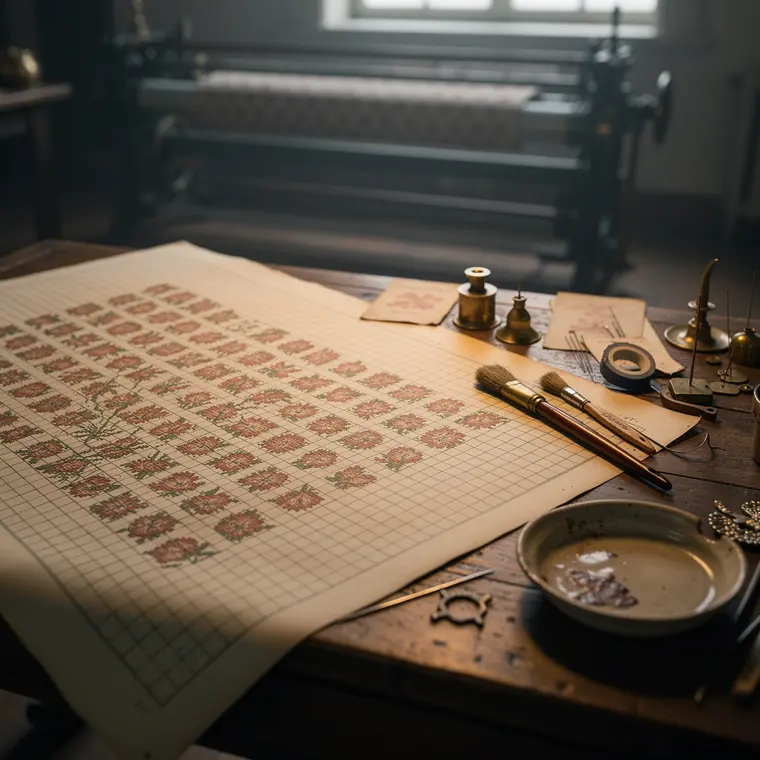
A large sheet of point paper ruled into thousands of tiny squares, a floral pattern painted onto it square by square in flat colour so that each filled square stands for one hook and one thread, the paint edges hard against the printed ruling, the sheet laid flat on a drawing table with a brush and a small paint dish beside it, the grid a pale cream, the pattern in muted red and green against it, a pattern designer's room with daylight from a north window, the far end of the table and the room beyond out of focus.
- What it was used for
- Point paper was the link between drawing and punched card. On this squared sheet each vertical space stands for one warp thread and so for one hook of the machine, each horizontal space for one pick of weft and so for one card. The draughtsman enlarged his sketch onto the paper by ruling both sheets in the same proportion, then painted in the squares - usually with vermilion or scarlet and crimson lakes; the lakes were more transparent and let the squares show through. The card cutter then read it: cut the red, pass the ground. The usual method was to turn the sheet upside down and read from right to left, beginning at the numbered end of the card (Bell 1895).
- What was new
- What was new was that a cloth could be calculated before it was woven. The paper's square size was not decoration but the machine's specification: "8 × 8" means eight needles in the row, and if 80 warp threads were to carry 100 picks per inch, the rule of three gave 8 × 10 - for 10 × 12½ one had to fall back on 10 × 12, since half squares could not be made, and on 12 × 14 instead of the unusual 12 × 15 (Bell 1895). Hook count and card count for a pattern could thus be worked out before a single card was cut. The catch: the paper now decided what could be designed. Bell shows a pattern that could not be used for a coarser cloth because it would not fit on the point paper. Often the forms had to be altered slightly to fit the paper.
What the sources leave open: No standard sheet sizes for point paper are documented; makers supplied special sizes to order. One case is documented: for a damask pattern after a design by Owen Jones, exhibited in London in 1873, the ruled sheet measured 16 feet by 9 feet 3 inches and yielded 9,312 cards for 29,088 warp threads. Any figure for "squares per inch" holds only for one type of paper. No working time or cost for a mise en carte was found.
Further reading
- T. F. Bell, Jacquard Weaving and Designing (London 1895), Kap. IV 'Designing and Draughting', S. 110-138, und Kap. V
- E. A. Posselt, The Jacquard Machine Analyzed and Explained (Philadelphia 1887), S. 103-112
- Alfred Barlow, The History and Principles of Weaving (London 1878), S. 166
- SILKNOW Thesaurus, 'Carton perforé' (Definition von lisage und mise en carte)