The Enumerator's Round
1890 · Census Schedule · Work 569 of 1,871
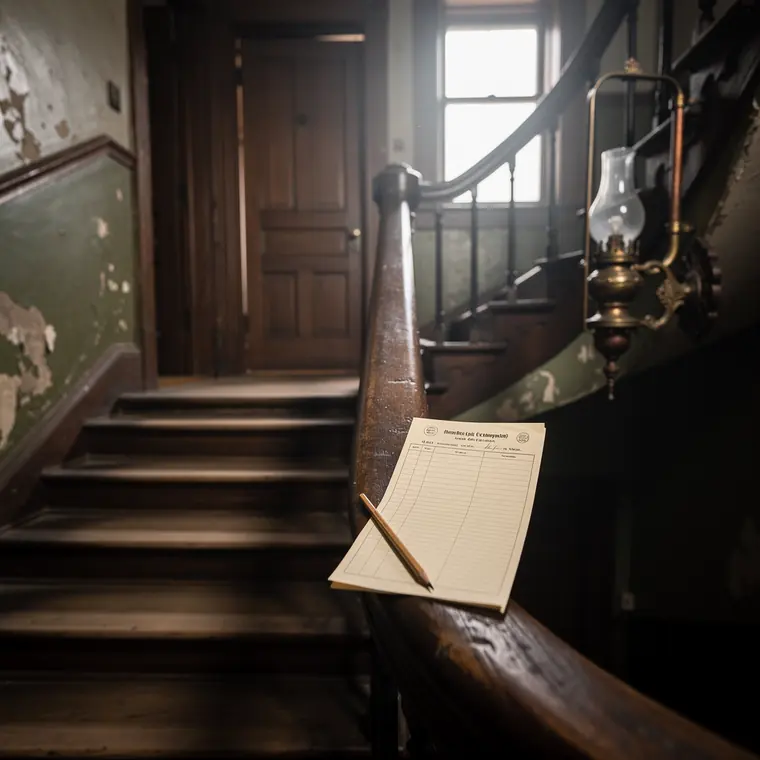
A tenement stair landing with several panelled doors, a folded census schedule and a pencil resting on the wooden handrail, the printed form ruled into columns with small printed headings, the ruled lines and printed heads alone carrying the form, the columns waiting to be filled, the paper cream against the dark varnished rail, worn treads leading up and down, daylight from a small landing window, a gas bracket on the wall, the doors and stair behind the schedule softly out of focus.
- What it was used for
- The enumerator's round was the fieldwork of the 1890 United States census: 46,408 enumerators under 175 supervisors appointed by the President, with no subdivision to exceed 4,000 inhabitants. Under the official instructions the enumerator had "to visit personally each dwelling in his subdivision, and each family therein". The reference day was 1 June; because that was a Sunday, enumeration began on 2 June. In cities that had over ten thousand inhabitants under the census of 1880 it had to be finished within two weeks - twelve working days, ending 14 June; everywhere else by 1 July. For 1890 there was a separate schedule for each family, 10½ by 15 inches, with 30 numbered inquiries and room for ten persons.
- What was new
- What was new was what came after the enumerator: his schedules had already been counted by office clerks with tally sheets in 1880 (Martin, Truesdell). The roughly 13 million schedules travelled physically to Washington; only there did clerks transfer the entries person by person onto punched cards. The enumerator was a pure collector - and was paid by the piece: at least 2 cents for each living inhabitant, 15 cents for each farm, 20 cents for each manufacturing establishment, 2 cents for each death reported, 5 cents for each surviving veteran enumerated. In return an oath bound him, and the law made quitting a crime: refusal made him guilty of a misdemeanour, liable to a fine not exceeding five hundred dollars. The instructions put it bluntly: "An enumerator can not throw up the work, therefore, simply because of dissatisfaction or indolence."
What the sources leave open: The number of enumerators varies: 46,408 at census.gov, "nearly 47,000" at the National Archives, "about 50,000" in T. C. Martin in 1891. By the wording of the act, the two-week deadline applies to cities with over ten thousand inhabitants under the census of 1880; one census.gov page states it the other way round. The text of the enumerator's oath is not printed in the instructions and was not found.
Further reading
- Instructions to Enumerators, Department of the Interior, Census Office, 1. Mai 1890
- Decennial Census Historical Facts: 1890, U.S. Census Bureau (46.408 Zähler, 30 Fragen, Kosten)
- Léon E. Truesdell, The Development of Punch Card Tabulation in the Bureau of the Census 1890-1940 (US GPO 1965), S. 39, 43
- T. C. Martin, Counting a Nation by Electricity, The Electrical Engineer, 11. November 1891
- About 1890, U.S. Census Bureau
- Kellee Blake, "First in the Path of the Firemen": The Fate of the 1890 Population Census, Prologue (NARA), 1996