The Census Floor
1890 · Clerical Labour · Work 571 of 1,871
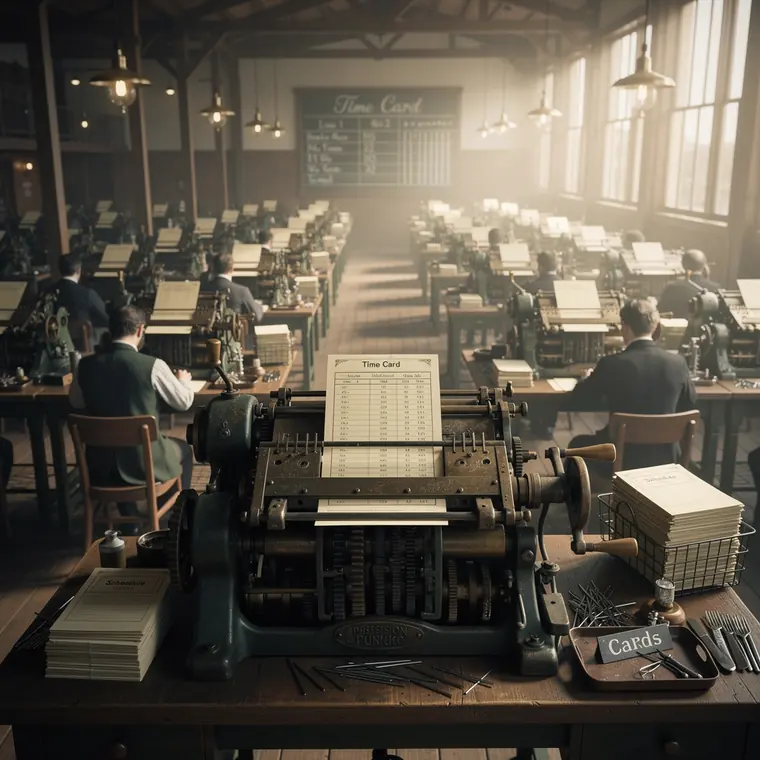
An enormous hall of punching stations in ranks, an identical pantograph punch at every place, clerks seated with their backs to the lens, wire baskets of schedules stacked at the aisle ends, a tall board on the far wall chalked with tally strokes, the nearest punch and its card in sharp focus in the foreground, the ranks receding into soft blur, tall windows along one wall admitting daylight, gas fittings hanging from a high ceiling, the floor in bare boards, the cards buff against dark iron.
- What it was used for
- The machine floor of the 1890 census occupied one of the upper storeys of the Interocean Building in Washington. The Hollerith machines stood there, and on entering, T. C. Martin heard a sound "for all the world like that of sleighing" - the monitor bells of the presses. The current came from the city's Edison lighting circuits by way of a bank of accumulator cells in the basement. The cards were in the basement too, in tin boxes 20 by 7 by 3½ inches holding a little under 2,000 each, in racks ten miles long. The schedules they had been punched from were stored across the street in an old church. In a small room, men corrected the cards the machines had rejected by reference to those schedules.
- What was new
- What was new was that office work became measurable. On the day of Martin's visit 81 clerks sat at the machines and got through 434,493 cards counted and 121,853 sorted, 556,346 in all, an average of 6,868 each. The Census Office kept a "roll of honor" with names, dates, numbers of readings and numbers of cards; the daily record was held by Maurice Alexander on 9 July with 19,071 cards. The reversal is inside those figures: in the first count the women, who worked during the day, averaged about 47,950 persons a day, the men, who came on at night, 32,935. The census cost, by the Census Bureau's own figure, 11,547,000 dollars, 18.3 cents per head. Superintendent Robert P. Porter was attacked fiercely over the census; of the Hollerith system he said, according to Martin, that he could not have got away from it.
What the sources leave open: The total number of Census Office employees cannot be reliably documented; what is documented from a primary source is only the 81 clerks at the machines on one day. The proportion of women cannot be quantified, only shown qualitatively. No rental rate for the machines in 1890 is documented; Truesdell's 1,000 dollars per machine per year refers explicitly to 1900. No congressional criticism specifically of the cost of the 1890 census was found.
Further reading
- T. C. Martin, Counting a Nation by Electricity (A Visit to the U. S. Census Office, Washington), The Electrical Engineer Vol. XII No. 184, 11. November 1891, S. 522-530
- Decennial Census Historical Facts: 1890, U.S. Census Bureau (Kosten 11.547.000 Dollar, 18,3 Cent je Kopf)
- Léon E. Truesdell, The Development of Punch Card Tabulation in the Bureau of the Census 1890-1940 (US GPO 1965)