Powers' Simultaneous Punch
1911 · Mechanical Tabulation · Work 573 of 1,871
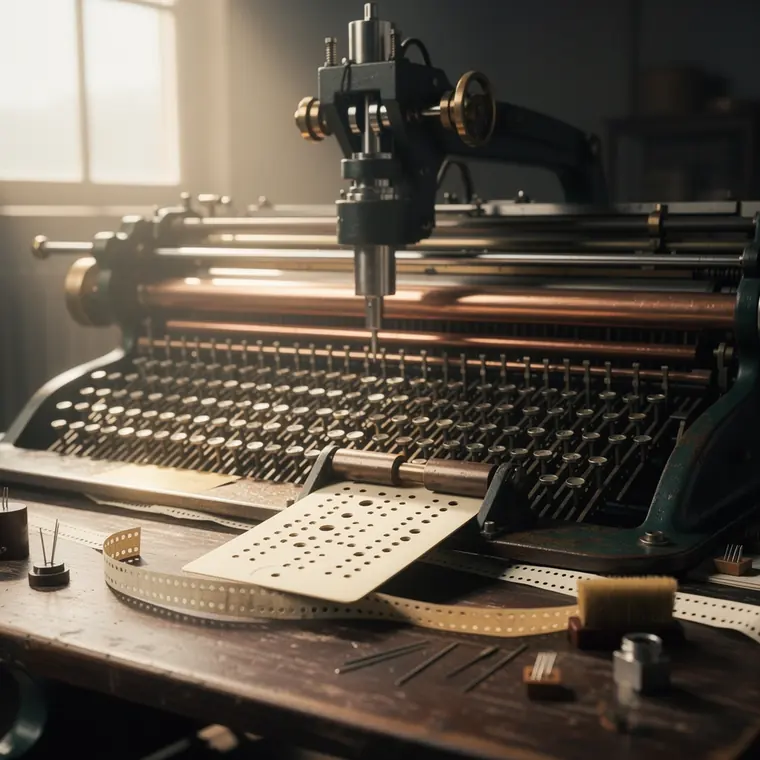
A punch that sets every hole of a card in a single stroke, a keyboard of levers set before it, the keys setting pins in a die and one pull driving them all through the card at once, the mechanism entirely of levers, rods and pins in bright steel and black iron, a card sitting in the die close to the lens, punched with round holes in a scattered pattern, the keyboard and its levers behind in soft focus, a punching room lit by daylight from a window.
- What it was used for
- James Legrand Powers was a machinist in the workshop of the U.S. Census Bureau; in 1907 he was detailed to develop an automatic card punch. His punch had 240 keys, struck as on a typewriter - but it did not punch on the stroke. The Report of the Director of the Census of 1 December 1909 describes it: "All the necessary keys for punching a given card are set before any of the holes are actually punched. An error in setting a single key can thus be readily corrected, whereas formerly if an error was made the card had to be destroyed, although many holes might have been already punched in it." In August 1909 contracts were let for 300 of these punches at 250 dollars each; for the 1910 census they punched 63.5 of 93.5 million cards.
- What was new
- What was new was the buffer. The keystrokes were held mechanically and punched all at once only when a thumb bar was pressed; in patent 992,246 Powers expressly claims means "to punch a plurality of holes simultaneously". The card could thus be corrected before the hole existed and no longer had to be destroyed for a wrongly set key. Then the reversal: in 1911 Powers left the bureau and founded his own company. The patents he had filed while in office had been granted to him personally, and they went with him. His machines worked purely mechanically rather than electrically - among other reasons, as the IEEE wiki puts it, because that would "help circumvent Hollerith's patents". The bureau itself was dissatisfied: Truesdell notes that the punch was "considered unsatisfactory" despite some 50 per cent higher output, because of frequent mechanical breakdowns. In 1927 the company was absorbed into Remington Rand.
What the sources leave open: Who permitted Powers to take the patents is not documented: census.gov says only that he "held the patent", and the IEEE wiki uses a passive with no actor. No authority, no decision, no date. Lars Heide judges the other way, calling Powers' Census machines "both were failures". For the 1910 card Truesdell gives 24 columns. The first name varies in the secondary literature between James and John.
Further reading
- Léon E. Truesdell, The Development of Punch Card Tabulation in the Bureau of the Census 1890-1940 (US GPO 1965), S. 125-129, 139 (zitiert den Report of the Director of the Census 1908-9, S. 19)
- US-Patent 992,246, Perforating Machine, James Powers, angemeldet 25. September 1908, erteilt 16. Mai 1911 (Ansprüche 21-22)
- Tabulation and Processing, U.S. Census Bureau History
- Emerson W. Pugh, Early Punched Card Equipment 1880-1951, IEEE Engineering and Technology History Wiki