The Rectangular Hole
1928 · 80-Column Card · Work 575 of 1,871
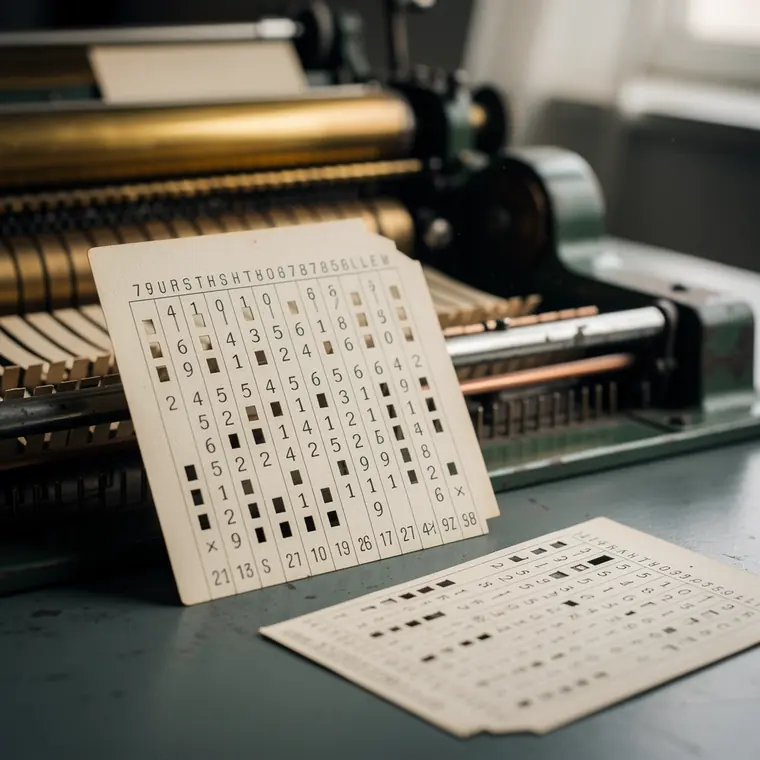
A stiff buff card with one corner cut, ruled into eighty narrow columns with the digits 0 to 9 printed down each column, rectangular holes punched in a scattered pattern, the column numbers printed minutely along the lower edge, the card lying flat close to the lens, the small rectangular holes crisp and evenly spaced, a second card beside it showing the same layout, a tabulating machine bed behind in soft focus, an office table lit by daylight from a window.
- What it was used for
- The rectangular hole was the core of the IBM card of 1928. On pasteboard of the same size - 7⅜ by 3¼ inches, as on the existing 45-column card - it carried 80 columns, that is 78 per cent more capacity. For that the columns had to stand closer, and narrower round holes would have spoiled two things: the contact time during sensing and the strength of the card. The patent says so itself: to maintain the necessary contact time, "the holes are elongated in the direction of card feed", and this form and spacing produce "considerable resistance to tearing". Thomas J. Watson had set two inventors to compete, Clair D. Lake and J. Royden Pierce; James W. Bryce assessed the designs and recommended Lake's, and Watson chose it.
- What was new
- What was new was a hole you could patent. US patent 1,772,492, filed on 20 July 1928 and granted on 12 August 1930, has exactly two claims, and both concern the hole shape alone: claim 1 the oblong apertures, claim 2 the rectangular ones. That shut the format off from competitors. Lars Heide writes that columns could be condensed without infringing IBM's patent, "as this only covered rectangular or oblong perforations"; Remington Rand went round it with a 90-column card and round holes. The reversal came from the courts. In the antitrust case against IBM, decided on 2 December 1935, the issue was the lease clause under which any use of other makers' cards terminated the contract - and there the court treated the unpunched cards as "entirely unpatented articles".
What the sources leave open: What was protected was the hole geometry, not the card as a commodity; to write that IBM held a patent on the card is a shortcut. The Supreme Court's 1936 affirmation could not be retrieved - what is documented is only the district court decision of 2 December 1935. On the year of Remington Rand's 90-column card Heide gives 1929, the IEEE wiki 1930. "Doubling" is advertising language: 80 against 45 is 78 per cent more.
Connections
Every connection names its kind. “Forerunner” on its own would be a claim.
- Follows fromThe Hollerith Card1890IBM knew the round-hole card well and changed it. Into the late 1920s it carried 45 columns of round holes. Against the rival proposal to keep the round hole, Clair D. Lake's smaller rectangular hole prevailed in 1928: 80 columns, holes of about 1 x 3 mm.Source: Computer History Museum (IBM 1401 restoration): Who invented the 80 column rectangular hole punched card? · Columbia University Computing History: Early Card Punch Machines
Further reading
- US-Patent 1,772,492, Record Sheet for Tabulating Machines, Clair D. Lake, angemeldet 20. Juli 1928, erteilt 12. August 1930 (Ansprüche 1-2)
- United States v. International Business Machines Corp., 13 F. Supp. 11 (S.D.N.Y.), Entscheidung vom 2. Dezember 1935
- The punched card, IBM History (1928, 80 Spalten, Lake/Pierce/Bryce/Watson)
- The Story of the IBM Card, IBM 1946
- Lars Heide, Punched-Card Systems and the Early Information Explosion 1880-1945 (Johns Hopkins UP 2009), S. 93, 119, 172
- Emerson W. Pugh, Early Punched Card Equipment 1880-1951, IEEE Engineering and Technology History Wiki (Watson wählt Lakes Entwurf)