The Verifier
1930 · Key Verification · Work 576 of 1,871
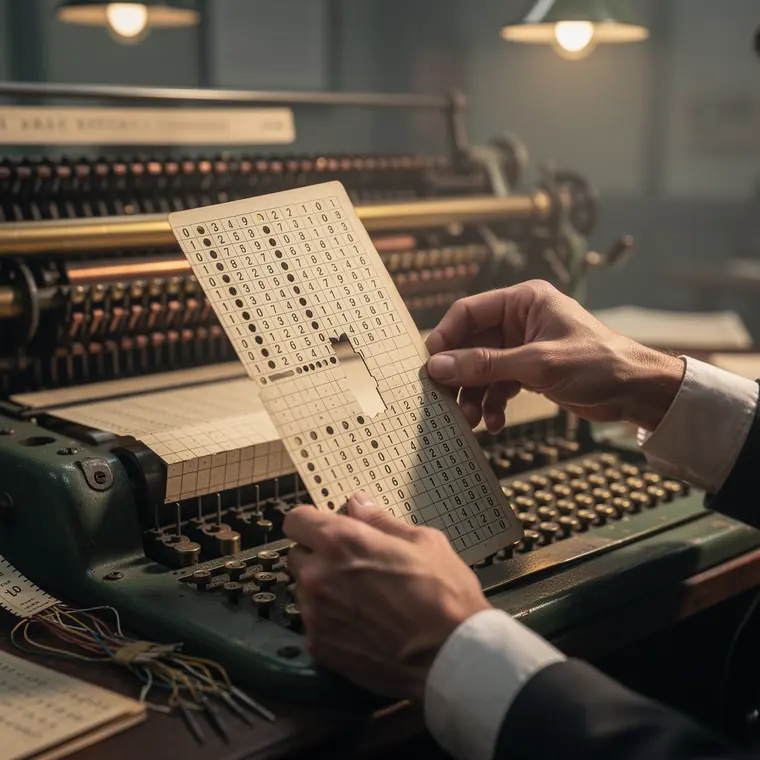
A machine built to the pattern of a key punch, a card bed and a keyboard before it, a second operator's hands retyping the same data so that the keys sense the holes already punched, a small notch cut in the card's end where the two agree, a stiff buff card with one corner cut, ruled into columns with the digits 0 to 9 printed down each column, rectangular holes punched in a scattered pattern, the card and the operator's hands close to the lens, the keyboard and mechanism behind in soft focus, a punch room lit by pendant lamps.
- What it was used for
- The verifier was the counterpart of the card punch: it did not punch, it compared. A second operator keyed the same entries from the schedule again, inserted the card that had already been punched, and the machine checked column by column whether keystroke and hole agreed. On the machine the Smithsonian dates to about 1935, the card advanced one place to the left when they agreed; when they did not, it stayed put, and a stroke of the blank key cut a hole at the foot of the offending column. The marked card went back to a punch and was keyed again. Not everything was verified: for the 1920 census of agriculture Truesdell lists 488 punches but only 47 verifiers.
- What was new
- What was new was that re-keying from the schedule no longer needed a second card. Before, a second operator punched a complete proof card, laid it over the first and held both up to the light; if the holes matched, the proof card was destroyed. James Powers describes this procedure in his 1914 patent 1,203,263 and replaces it with a machine in which the card "can be immediately checked as to the correctness of its perforations" - saving the proof card, the labour of punching it and the loss of destroying it. The solutions then diverged widely: with Powers, light through a wrong hole betrayed the error; from 1932 a Remington Rand machine searched for the round hole that had not been widened and inserted a signal card; with IBM the keyboard locked and a lamp came on.
What the sources leave open: An "IBM Type 55 Verifier" of 1930 could not be documented. Columbia University's type list gives the IBM verifiers as the 056 of 1949 and the 059 of 1964; the IBM manuals name the Type 56; the Smithsonian dates its machine to about 1935 and the product's introduction to "around 1917". Piece rates for women punch operators were not found; on errors Truesdell gives only 1920: machine verification rejected nearly 17 million cards (16 per cent), about 8 million were repunched.
Further reading
- US-Patent 1,203,263, Statistical-Card-Verifying Machine, James Powers, angemeldet 31. Oktober 1914, erteilt 31. Oktober 1916
- IBM Verifier for Punched Cards, Smithsonian National Museum of American History, Objekt nmah_694445 (ca. 1935; Prüfmaschinen 'around 1917')
- IBM 56 Card Verifier, Customer Engineering Manual of Instruction, Form 223-6026-6, September 1962 (Fehlerlampe, Tastatursperre, Kerbung)
- Lars Heide, Punched-Card Systems and the Early Information Explosion 1880-1945 (Johns Hopkins UP 2009), S. 94
- Léon E. Truesdell, The Development of Punch Card Tabulation in the Bureau of the Census 1890-1940 (US GPO 1965), S. 107, 136
- IBM Key Punches, Columbia University Computing History (Typenliste 056/1949, 059/1964)