The Card Stock Room
1940 · Card Supply · Work 577 of 1,871
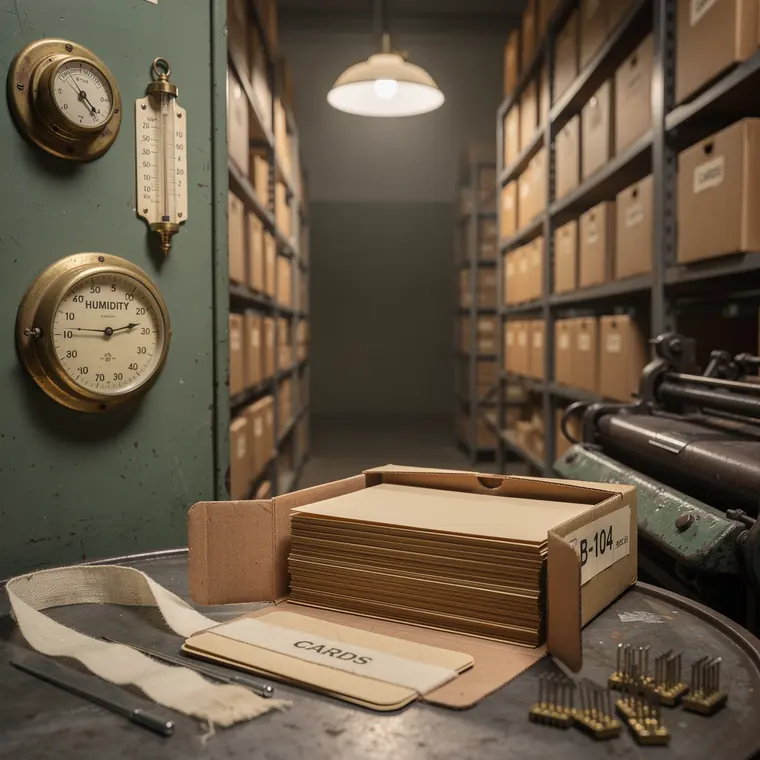
Shelves of sealed boxes of blank cards from floor to ceiling, the boxes in plain brown card with plain labels, a few boxes open showing the buff card edges, a humidity gauge on the wall and a thermometer beside it, the nearest box and its stack of fresh cards close to the lens, the shelving receding into soft blur, a storeroom lit by a single pendant lamp, a concrete floor, the cards warm buff against grey steel shelving.
- What it was used for
- The card stock room was where a punched-card department kept its supply of paper. IBM shipped cards in boxes of 2,000 or 10,000; the large ones came in moisture-proof corrugated containers, the small ones in wooden cases at extra charge, which in many installations then served as card files. The care was for the paper itself. IBM wrote in 1936 that changing atmospheric conditions caused paper to swell or curl to various degrees depending on its composition and manufacture. A card was therefore allowed to vary from its standard thickness of 0.0065 inch by no more than 0.0005 inch, and from its standard width of 3.25 inch only by -0.003 to +0.007 inch. At the plant the paper rolls were stored for several months before being converted into cards. IBM said it held a reserve covering more than three months of card demand and printed at two distant places, Washington and Endicott, so that fire or flood could not cut off the whole supply.
- What was new
- What was new was not the card but how precisely it was made. IBM tested every delivery of paper in its laboratory for ten properties, among them fibre structure, thickness, bursting strength, folding endurance, sizing and the stiffness the manual calls "card effect". Before slitting, the web ran through a speck detector: brushes carrying a higher voltage than the accounting machines swept every part of the surface, and a striper brush marked a defective spot over about 16 inches. The reason was that a carbon or slime spot in the paper could complete a circuit that only a hole was meant to complete. This care carried a business. The Supreme Court recorded in 1936 that IBM made and sold 3,000,000,000 cards a year, 81 per cent of the total, and that over the preceding ten years card sales had averaged $3,192,700 a year against $9,710,389 from machines. On 27 April 1936 the Court held the lease condition tying customers to IBM cards unlawful.
What the sources leave open: The widely quoted card thickness of 0.007 inch is not documented in the sources used here; IBM itself gave 0.0065 inch in 1936. No annual output figure for the 1940s was found; what is documented is three billion cards a year (Supreme Court, 1936) and 32 presses at Endicott printing five to ten million cards a day in 1937 (IBM archive). What IBM did after the ruling is not documented here.
Further reading
- IBM, Machine Methods of Accounting, Kap. AM-3: The Electric Accounting Machine Card (Copyright 1936)
- International Business Machines Corp. v. United States, 298 U.S. 131 (1936)
- IBM, The punched card (IBM History)
- International Business Machines Corp. v. United States, 298 U.S. 131 (1936), U.S. Reports (Library of Congress)