Do Not Fold, Spindle or Mutilate
1955 · Card Handling · Work 578 of 1,871
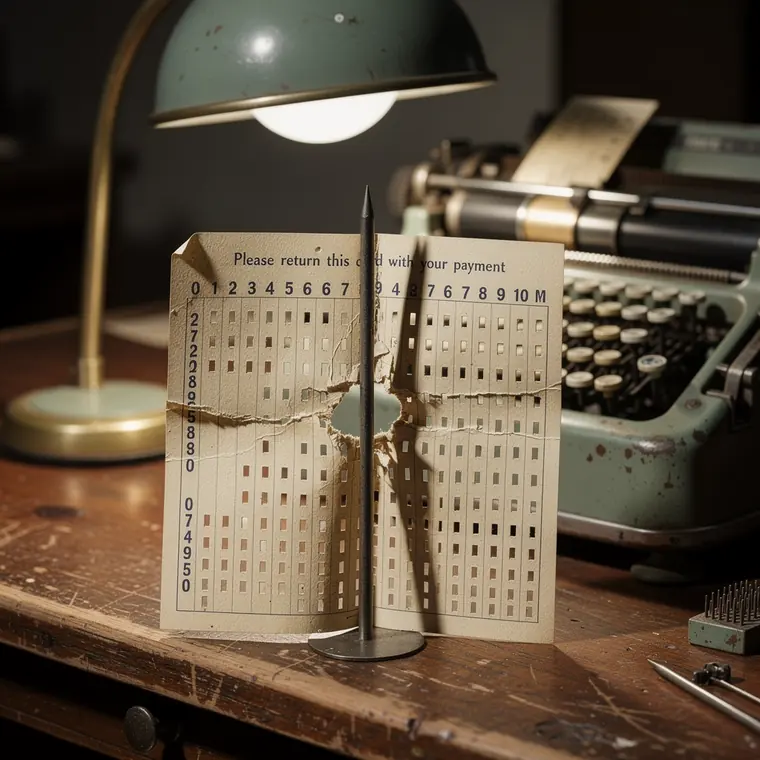
A stiff buff card with one corner cut, ruled into columns with the digits 0 to 9 printed down each column, rectangular holes punched in a scattered pattern, a single short line of small printed instruction type across its upper face, the card sent out as a bill and returned creased, a bill spindle standing on a desk beside it, the card pierced through by the spindle with a torn round wound in the punched data area, the crease running across the columns, the card close to the lens, an accounts office desk behind in soft focus lit by a desk lamp.
- What it was used for
- "Do not fold, spindle or mutilate" was a handling instruction printed on punched cards that went out to members of the public. A spindle was an upright spike on a clerk's desk; each finished paper was impaled on it, and when it was full the bundle was tied with string and sent to the archives. Steven Lubar writes that such warnings appeared in the 1930s, when punched cards reached the public, early on in 1933 on the punch card checks of the Agricultural Adjustment Administration, and from 1936 on Social Security checks. Earlier wordings were "Do not fold or bend this card" on University of Iowa registration cards and "Do not fold, tear, or mutilate this card" in an IBM sales brochure.
- What was new
- What was new was not the sentence but what became of it. The phrase became a slogan at Berkeley. A Daily Californian editorial of 7 April 1964 described a student's sense of being one out of 27,500 IBM cards in the registrar's office. Lubar reports, citing "Letter from Berkeley" in the magazine Despite Everything of January 1965, that one student pinned a sign to his chest: "I am a UC student. Please don't bend, fold, spindle or mutilate me." Students burned registration cards and punched FSM and STRIKE into blank ones. An instruction meant to protect the card from people became the image of people being treated like cards.
What the sources leave open: The year 1955 is not documented: Lubar gives no first attestation of the canonical wording and says plainly that its origin is lost. A scan and a text mirror of the article from the Journal of American Culture, Winter 1992 (pages 43-55) were consulted; neither showed the volume or issue number.