IBM 285 Electric Tabulator
1933 · Printing Tabulator · Work 580 of 1,871
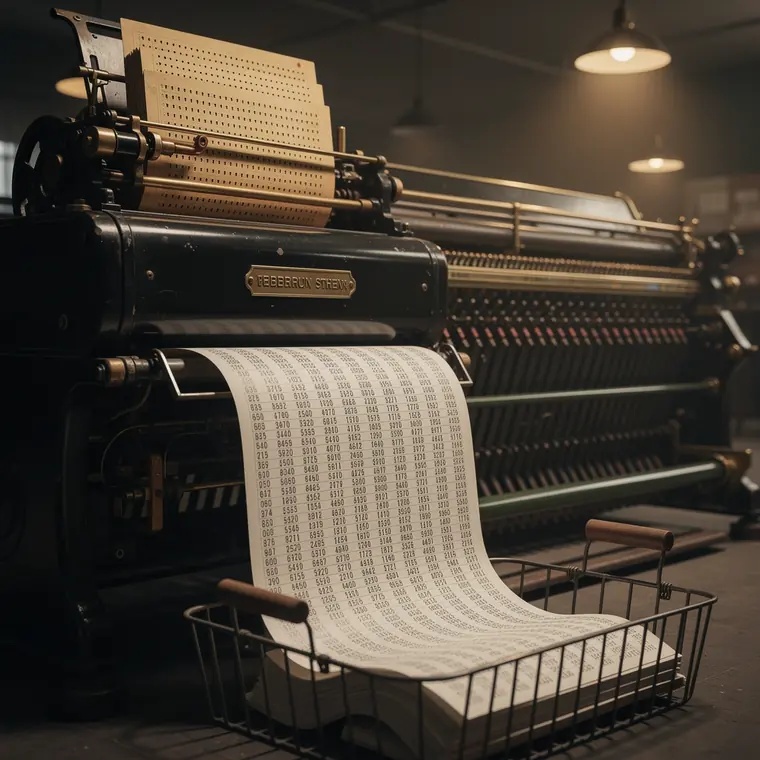
A wide printing tabulator with a card feed at the top left and a print unit running the full width of the right side, a continuous fanfold listing spilling from the printer into a wire basket on the floor, the listing carrying columns of numerals as an even grey texture of type, a stack of buff cards in the feed close to the lens, the machine in black enamel with a plain nameplate, the printing carriage and its type bars behind in soft focus, a tabulating room lit by pendant lamps.
- What it was used for
- The Type 285 was IBM's numeric accounting machine of the 1930s: it read punched cards, added and subtracted, and printed lists and totals on forms. IBM describes it in 1936 together with the larger Type 297 as a numerical printer capable of direct subtraction and using the same removable control panel. Columbia University puts its speed at up to 150 cards a minute; the machine pictured there had five counters. It was used wherever decks of cards had to become totals: payrolls, sales analyses, inventories, statistics. Columbia University's astronomical computing bureau worked with one too.
- What was new
- What was new, according to IBM in 1936, was the controlled counter, balance printing and the automatic plugboard; automatic group control IBM counted among the functions of tabulating machines generally. IBM describes in 1936 how the machine senses each card twice: if the holes under the upper, control brushes fail to agree with those under the lower, adding brushes, it stops, prints the total for the group that has just ended, clears the counters and continues with the next group. The machine thus notices for itself where a department or an account ends. What it could not do was letters; it printed digits only. The more expensive Type 405 of 1934 could print names as well. Yet according to Bashe and others, at the end of 1943 30 per cent of the 10,000 tabulators IBM had on rental were still Type 285 and 64 per cent Type 405: the cheaper machine that knew no names held its place beside the Type 405 for a decade.
What the sources leave open: The speed of 150 cards a minute and the count of five counters come from Columbia University's page; the IBM manual of 1936 (chapter AM-16) gives the Type 285 two to five counter banks and a speed of "75/75, 75/150, 120/120, 120/150" without a unit. Columbia expressly attributes the 1943 rental figures to Bashe et al., IBM's Early Computers (1985); that book was not consulted directly.