The Reproducing Punch
1935 · Card Duplication · Work 581 of 1,871
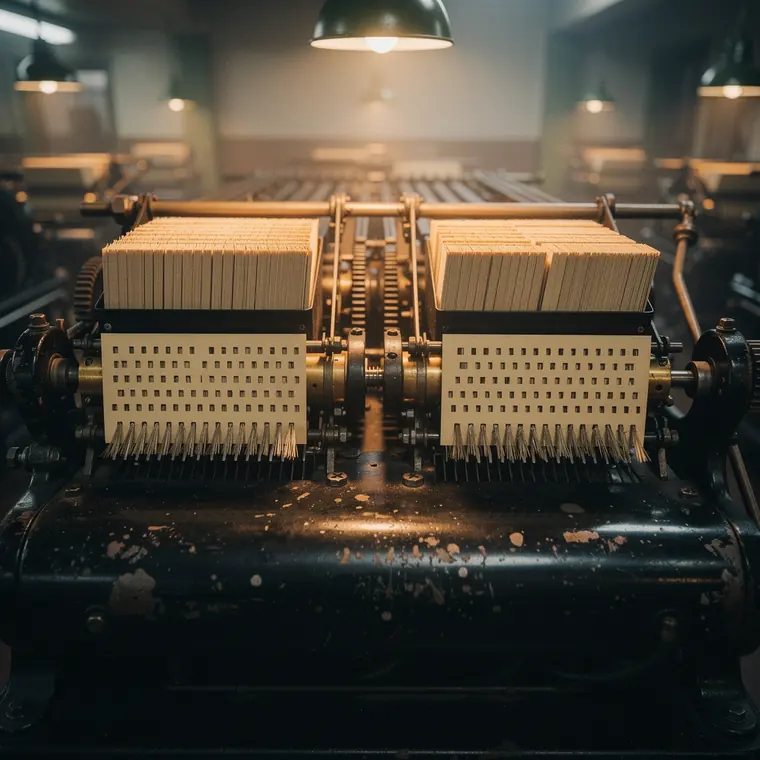
A machine with two card paths side by side, a reading station on one and a punching station on the other, one deck read and an identical deck punched from it, brush contacts visible where the read path passes beneath a row of fine wire brushes, cards in both hoppers close to the lens, the cards buff with rectangular holes, the brushes in dull brass and steel, the machine body in black enamel, the far side of the machine in soft focus, a machine room lit by pendant lamps.
- What it was used for
- The reproducing punch copied holes from card to card without anyone typing them again. IBM lists it in 1936 as the Type 512. It ran at a constant 100 cards a minute whatever the number of columns or holes to be transferred. It did two things. In reproducing, one deck was copied into another, if wanted with the fields rearranged. In gang punching, the contents of a master set-up card were written into many detail cards, and the change to the next master card happened by itself in the same run. It was used wherever the same entry had to appear on many cards: such as date, branch or department.
- What was new
- What was new was that the machine took over most of the work of the duplicating key punches and the motor-driven gang punches; that is IBM's own description. Through the control panel, fields could be moved, fields enlarged, and the control punches in rows 11 and 12 transferred or eliminated. The second novelty was self-checking. The International Comparing Reproducer carried extra comparing brushes; each card was verified one machine cycle after it was punched, and if the two sensings differed, the machine stopped and a red light burned until the operator had corrected it and reset the machine. What this verified was the fidelity of the copy, not the correctness of the source: an error in the master card was passed on as correct, a hundred times a minute.
What the sources leave open: No year of introduction can be established with confidence. IBM's manual (chapter AM-19, copyright 1936) describes the machine as the Type 512; Columbia University gives no date for the Type 513 and dates the Type 514 to 1945. The year 1935 is supported only by the 1936 chapter counting the machines among advances recently made.