The Interpreter Type 552
1937 · Card Printing · Work 585 of 1,871
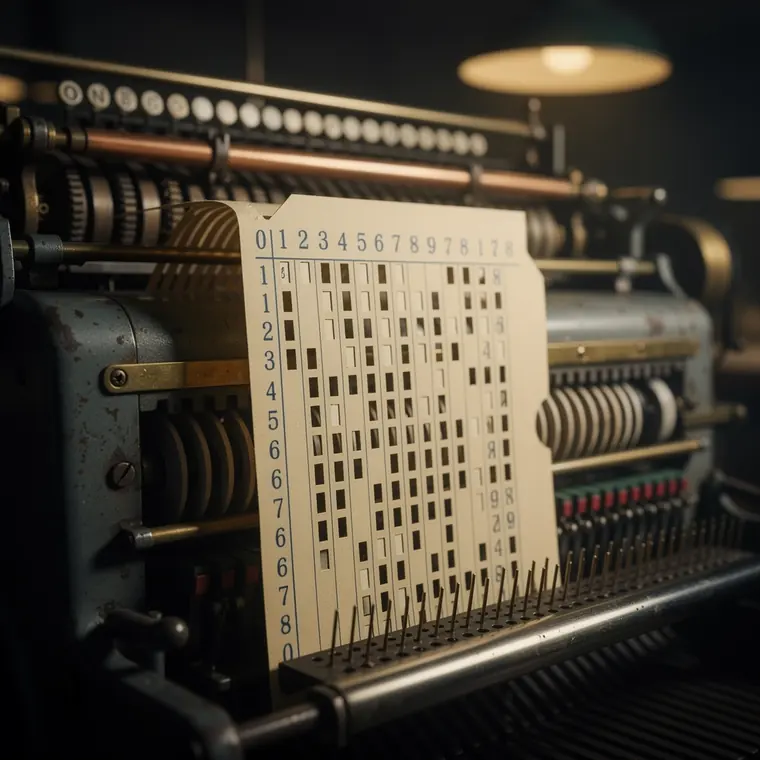
A machine reading the holes in a card and printing along its top edge, a card emerging from the print station with a fresh line of small type across its upper margin, a stiff buff card with one corner cut, ruled into columns with the digits 0 to 9 printed down each column, rectangular holes punched in a scattered pattern, the emerging card close to the lens, the type wheels and the ribbon behind in soft focus, the machine in grey enamel, a machine room lit by pendant lamps.
- What it was used for
- The interpreter printed on the punched card what its holes meant, so that a person could read it. The Type 552 was the version for letters as well as figures. It read up to 60 columns in one pass and printed them in one row, or two if wanted, on the card; two passes covered all 80 columns. It ran at 60 cards a minute. The printed characters are wider than the card columns and so do not line up with them. The machine was used for files that people looked things up in by hand.
- What was new
- What was new was the letter from an interpreter; IBM's Type 34 alphabetic printing punch was already printing letters on cards as it punched them in 1936. IBM's own 1935/36 manual knows only numeric interpreters: the Type 550 with 45 columns at 75 cards a minute, and the Type 551 for cheque writing at 60 cards a minute, with special pin-point type and asterisks printed automatically to cancel unused positions in the dollar amount. The real point is why this class of machine existed at all: the punched card was unreadable to its own users. A filing clerk cannot read holes. So a separate machine was needed to translate the machine format back into writing, and it did so more slowly than the tabulator processed the cards.
What the sources leave open: The year 1937 could not be substantiated. Columbia University dates the Type 552 to 1946, relying on IBM form 22-3178-3 of 1946; the Computer History Museum dates its object to "circa 1946". The Type 552 does not appear in IBM's 1935/36 manual.
Further reading
- Columbia University Computing History: IBM Card Interpreters (550, 551, 552)
- Computer History Museum, Katalognummer 102757364: IBM 552, 60 column Alphabetical Interpreter, ca. 1946
- IBM, Machine Methods of Accounting, Kap. AM-18: Interpreters, Types 550 und 551 (Copyright 1936)
- IBM, The IBM 077 Collator (IBM History): 405 mit 150 Karten je Minute