The Machine Room Floor
1940 · Tabulating Installation · Work 586 of 1,871
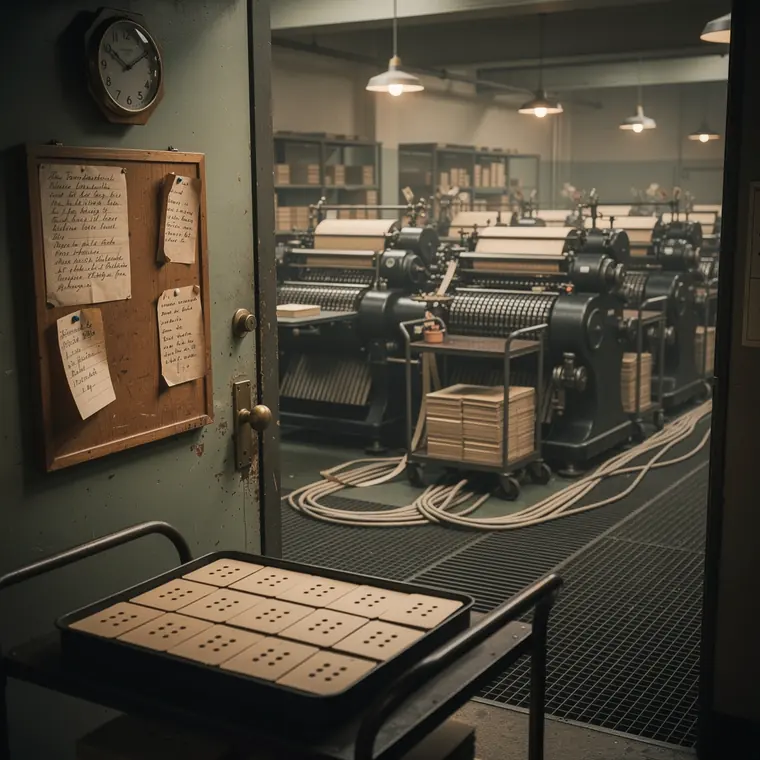
A room of sorters, tabulators and punches, cable troughs running beneath metal floor grilles, trolleys of card trays parked between the machines, a wall clock and a job board by the door, a tray of cards on the nearest trolley close to the lens, the cards with one corner cut and rectangular holes punched in a scattered pattern, the machines in black and grey enamel receding into soft focus, their card hoppers and stackers loaded, pendant lamps along the ceiling, the cards buff against the grey enamel and the dark floor.
- What it was used for
- The machine room was where a firm's punched-card work came together: punches, sorters, tabulators, card cabinets. IBM set out in 1936 how it should look. It should be well lighted and well ventilated, with ample space around each machine for operation and maintenance. Where several punch operators worked, a separate key punch room was preferable, so that no cards other than current work reached the sorting and tabulating room. Sorters were placed parallel and facing each other, or in a U, so that one person could run several; two tabulators facing each other counted as a unit for one operator. To these were added card files of about twenty drawers holding some 60,000 to 70,000 cards in all.
- What was new
- What stands out is that an office room was laid out to the rhythm of machines, and that the layout came from the firm that rented the machines out. IBM supplied a chart of the department's flow of work as well, from the code clerk through the key punch operator and the senior key punch operator to the machine operator who was also department supervisor, and up to the office manager. One figure shows how large this became: by the end of 1943 IBM had 10,000 tabulators on rental, according to Bashe and others; for the 1940 census, the Census Bureau states, workers had to transfer the schedules by hand onto 175.6 million punch cards. The barb is in Thomas Haigh: the tabulating room, he writes, was a noisy, stuffy place often consigned to a basement or other out of the way location. The room where a firm's figures were made was the one it did not show.
What the sources leave open: No noise levels in decibels, floor loadings or 1940 rental prices were found; Haigh's description is qualitative. His figures on the division of labour between men and women come from a 1958 survey in Oklahoma City and do not apply to 1940. The figure of 10,000 tabulators on rental is reported by Columbia University after Bashe et al. (1985); that book was not consulted directly.
Further reading
- IBM, Machine Methods of Accounting, Kap. AM-6: Organization and Supervision of the Tabulating Department (Copyright 1936)
- Thomas Haigh, Masculinity and the Machine Man: Gender in the History of Data Processing, in: Gender Codes, hrsg. Tom Misa, IEEE Press 2010
- U.S. Census Bureau, 1940 Census Snapshot, technische Dokumentation