The Timekeeper's Deck
1928 · Piecework Recording · Work 587 of 1,871
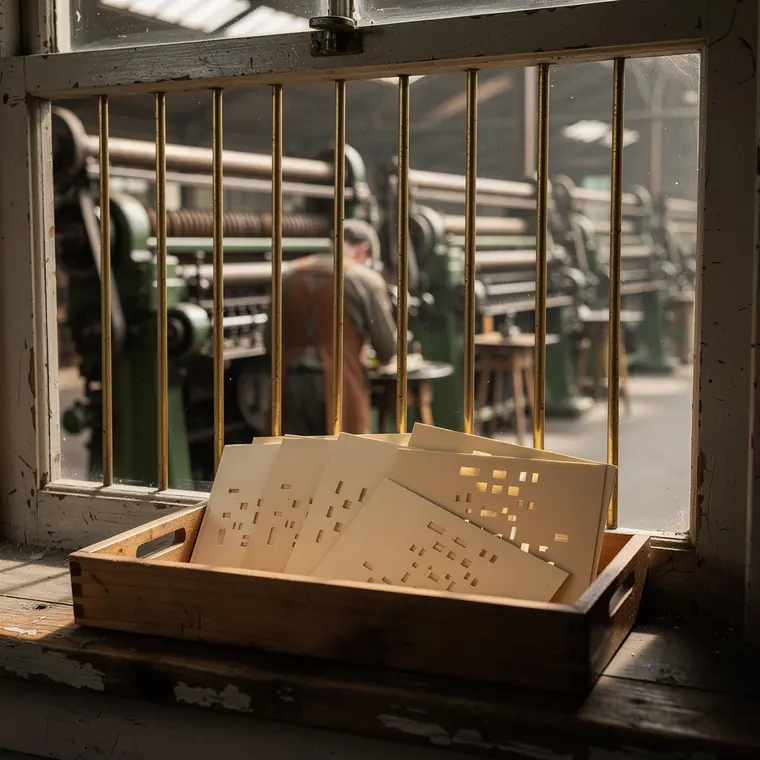
A shallow wooden tray of stiff buff cards standing on the worn sill of a small office window onto a factory floor in 1928, the cards seen from behind and edge-on, plain smooth buff backs, each with one corner cut and a scattered pattern of small rectangular holes with daylight showing through, the tray close to the lens, behind it a brass grille of plain vertical bars, clear bare window glass, beyond the glass the shop floor with green painted machine tools and belt shafts in soft focus, one worker seen from behind in a brown apron, daylight from a factory skylight above, bare painted wooden window frame.
- What it was used for
- The timekeeper's deck recorded who had worked how long on what. IBM describes the procedure in 1936: a worker's time card was usually a dual tabulating card, both written and punched, and was either a job ticket covering a single job or a daily time report covering all the jobs of the day. At the end of the day the elapsed time was computed from the clock registrations and checked against the attendance record; then the card was rated, extended and punched. IBM's own demonstration example reads: Department 31, Man No. 189, J. M. Franklin, 2 December, Order No. 345, Operation No. 16, two and a half hours, seventy-five good pieces at two cents each, $1.50, direct labour. In IBM's demonstration, ten to twenty-five such cards accumulated per worker over a pay period.
- What was new
- What was new in 1928 was the card, not the clock. IBM's own chronology records for that year that the punched card was made to hold 80 columns, almost double its previous capacity. The time clock was older: IBM's manual claims for 1888 what it calls the world's first mechanical time recorder; IBM's chronology names the jeweller Willard Bundy as its deviser, and his brother Harlow organised the manufacturing company only the following year. And the clocks did not punch, they printed. IBM describes the Job Time Recorder as furnishing printed records of the start and finish of every job on any kind of job ticket; the attendance recorder used a two-colour ribbon to print late arrivals and early departures automatically in red. The link to the punched card was made afterwards, by a person at the key punch. IBM called the attendance recorder's record accurate, indisputable and unchangeable.
What the sources leave open: No innovation in time recording could be documented for 1928; the year is attested only as that of the 80-column card. No sales figures for time clocks were found.
Further reading
- IBM, Machine Methods of Accounting, Kap. AM-23: Other International Products (Zeiterfassung), Copyright 1936
- IBM, Machine Methods of Accounting, Kap. AM-22: Application of Machines to Accounting Functions (Copyright 1936)
- IBM, Highlights of IBM History, Form G520-1580-5 (Armonk, April 1971), Eintrag 1928
- IBM, Machine Methods of Accounting, Kap. AM-7: Selection and Training of Key Punch Operators (Vorführtext mit Job Ticket J. M. Franklin), Copyright 1936