The Payroll Run
1930 · Payroll Tabulation · Work 588 of 1,871
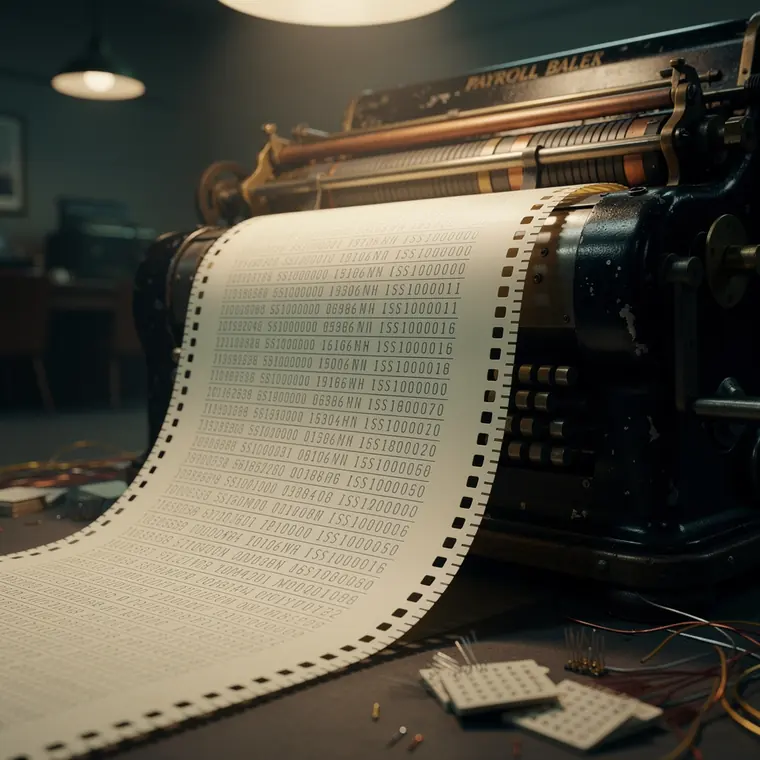
A tabulator printing a continuous payroll listing, the fanfold folding itself into a stack on the floor, line after line of type stepping down the paper as an even grey texture of figures, the print unit and the ribbon close to the lens, the fanfold sprocket edge in sharp focus, the stack on the floor and the machine body dropping into soft focus, the paper cream against black enamel, a tabulating room lit by pendant lamps.
- What it was used for
- The payroll run was what a punched-card department did at the end of each pay period. IBM describes it in 1936 like this: for every employee there was a master card with name, department and clock number. To these were added the period's time cards and one card for each deduction, for instance insurance, savings, purchases or advances. At the end of the period the master, payroll and deduction cards were machine-sorted together by department and employee number and tabulated onto the payroll sheet; the machine applied the deductions automatically. While the payroll was printing, a summary card could be punched for each employee, and that card could serve as the pay cheque itself. The same cards yielded current wage statistics and, at the year's end, income tax reports.
- What was new
- What was new was the speed, and what the speed did to the payroll. IBM's 1936 demonstration script does the arithmetic: the accounting machine adds at 9,000 cards an hour, which with five counters is 45,000 items an hour as against 2,000 items an hour, which is good production on a keyboard adding machine; a payroll sheet for 25 men is complete in less than five minutes. A figure from outside: in the Journal of Accountancy of April 1934, Raymond V. Cradit, expressly following Eichenauer and based on the wages of one hundred men, reports that the monthly payroll had taken twelve working days before and four after. The price sat at the head of the chain: the figures still had to be turned into holes by hand, at 250 to 800 cards an hour.
What the sources leave open: Cradit attributes the twelve-to-four working days to a third party named Eichenauer; he does not give that publication and it was not found. No named large firm was found that documents, together, its headcount, card volume, before-and-after times and staff savings.
Further reading
- IBM, Machine Methods of Accounting, Kap. AM-22: Application of Machines to Accounting Functions, Abschnitt Payroll and Labor Accounting (Copyright 1936)
- IBM, Machine Methods of Accounting, Kap. AM-7 (Vorführtext: 9.000 Karten je Stunde, Lohnliste für 25 Mann), Copyright 1936
- Raymond V. Cradit, Punched-card method in accounting, The Journal of Accountancy, April 1934 (Vol. 57, No. 4)