The Ration Office
1943 · Rationing Record · Work 592 of 1,871
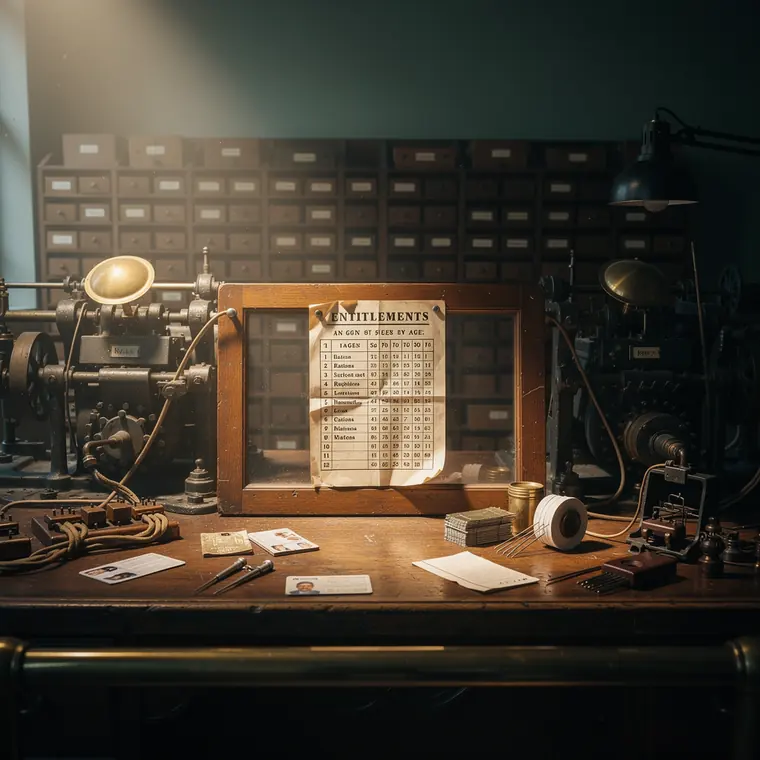
A public counter with a queue rail, behind it card trays for every household in the district, a clerk's window with a printed schedule of entitlements by age pinned to the frame.
- What it was used for
- A ration office was the counter where households and dealers collected their ration books and settled their coupons. In the United States this was done, according to the responsible agency's own retrospect, by "more than 5,600 War Price and Rationing Boards" — local boards spread across the country. On 30 June 1945, the same Office of Price Administration reports, more than 100,000 volunteers served there, assisted by only about 27,000 paid employees. One of each ration book had to reach every civilian, by the agency's estimate "about 130,000,000 people". In Britain the Minister of Food, Colonel Llewellin, told the House of Commons on 9 June 1944 that in one office from which he had a report "it takes only 15 seconds, if a person's documents are in order, to issue a new ration book".
- What was new
- What was new was not a machine but an account. For dealers and large consumers the Office of Price Administration set up "ration banking": stamps and coupons were credited to ration accounts at ordinary banks, in the agency's words "with ration accounts in the banks serving just like dollar checking accounts". Rationing thus left the counting room and ran through the existing payments system; coupons became a second currency with deposits and clearing. The price is stated in the agency's own report: "counterfeiting of ration stamps and coupons grew to the point where it was necessary to examine them". Turn paper into money and you must guard it like money — in the end the administration was inspecting for forgery the coupons it had invented itself.
What the sources leave open: No evidence was found for punched-card machinery in ration offices. The 1939 Register for England and Wales behind the ration books held some 40 million people, per The National Archives, in "more than 65,000 volumes (transcript books)". The other figures come from the administration's own accounts: the OPA report of 1946 and Hansard 1944.
Connections
Every connection names its kind. “Forerunner” on its own would be a claim.
- Follows fromThe National Register1939The ration book came out of the register. The returns of the registration of 29 September 1939 served first for identity cards and then, "once rationing was introduced in January 1940, to issue ration books". The register was kept up to date by the Local National Registration Offices and the Food Offices.Source: 1939 Register - research guide, The National Archives (UK)