The Hospital Admission Card
1950 · Medical Records · Work 593 of 1,871
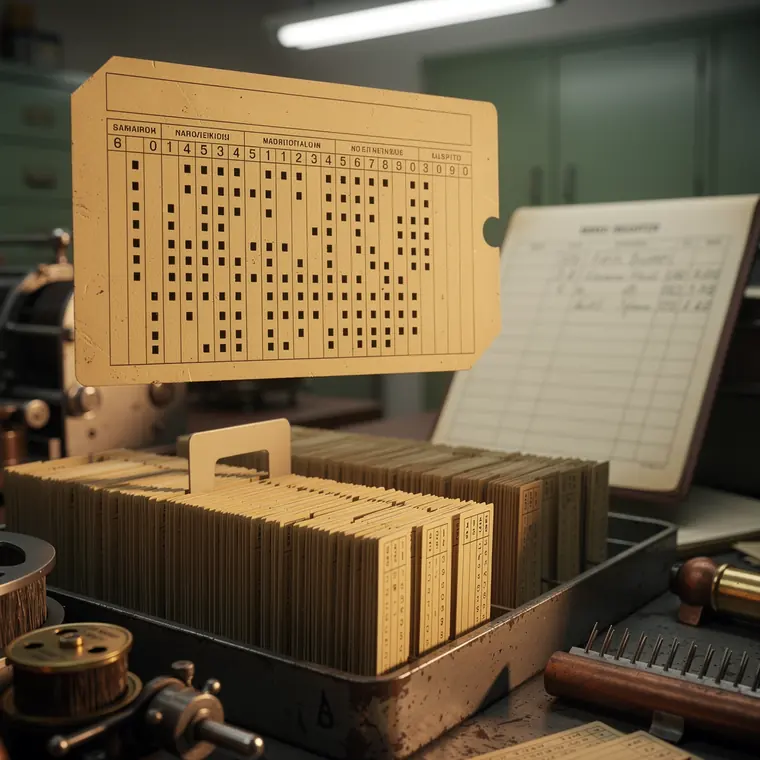
A punched card printed with ruled field boxes across its top, a stiff buff card with one corner cut, ruled into columns with the digits 0 to 9 printed down each column, rectangular holes punched in a scattered pattern, the punched pattern alone carrying the record, the card filed in a tray with several hundred others behind a plain guide tab, a ward register open beside the tray with ruled lines and clear entry spaces, the card close to the lens, the tray and the register behind in soft focus, a hospital records office lit by fluorescent tubes.
- What it was used for
- When a patient left hospital a short abstract was made from the case notes: age, sex, diagnosis, length of stay, outcome. These items were coded and punched into a card so that cases from every hospital could be counted together. For England and Wales the practice is tangible in the archive: The National Archives lists RG 26/89, "Machine punch cards: instructions for punching of mental health records", dated 1949-1950 — an official punching instruction for psychiatric records. The Hospital In-Patient Enquiry took, according to Geoffrey Rivett (Nuffield Trust), a ten per cent sample of admissions to all hospitals in England and Wales. In the United States the National Center for Health Statistics described its method in 1966: "The coded information on the conventional abstract form was reproduced on a punchcard."
- What was new
- What was new was that the single case became countable. The card made every admitted patient a record of its own, re-sortable by diagnosis, length of stay or outcome, and it made one hospital comparable with another. The archivist Barbara L. Craig names the precondition and dates it after the Second World War: "general acceptance of the international system of classification permitted standardization of statistics among hospitals". The aim of the American survey was "to produce, on a continuing basis, national hospital patient statistics". The barb is in the scope: on Rivett's account the English sample left out cases of mental illness and disability — precisely the group for which the punching instruction of 1949-1950 was written.
What the sources leave open: The often-quoted start year 1949 for the Hospital In-Patient Enquiry could not be confirmed; what is documented is the file series RG 26/112 (1948-1955) and sampling instructions of March 1955; Rivett gives the start as "Since 1948". Figures on the American Professional Activity Study sat behind paywalls and are therefore absent.
Further reading
- RG 26/89, Machine punch cards: instructions for punching of mental health records, 1949-1950, The National Archives (UK)
- Geoffrey Rivett, 1958-1967: The renaissance of general practice and the hospitals, Nuffield Trust
- Patients Discharged From Short-Stay Hospitals: United States, Oct.-Dec. 1964, Vital and Health Statistics Series 13 No. 1, NCHS, Oktober 1966
- Barbara L. Craig, Hospital Records and Record-Keeping, c. 1850 - c. 1950, Part II, Archivaria 30 (1990)
- RG 26/112, Hospital In-patient Enquiry: summary and instructions, 1948-1955, The National Archives (UK)