The Dropped Deck
1950 · Deck Ordering · Work 594 of 1,871
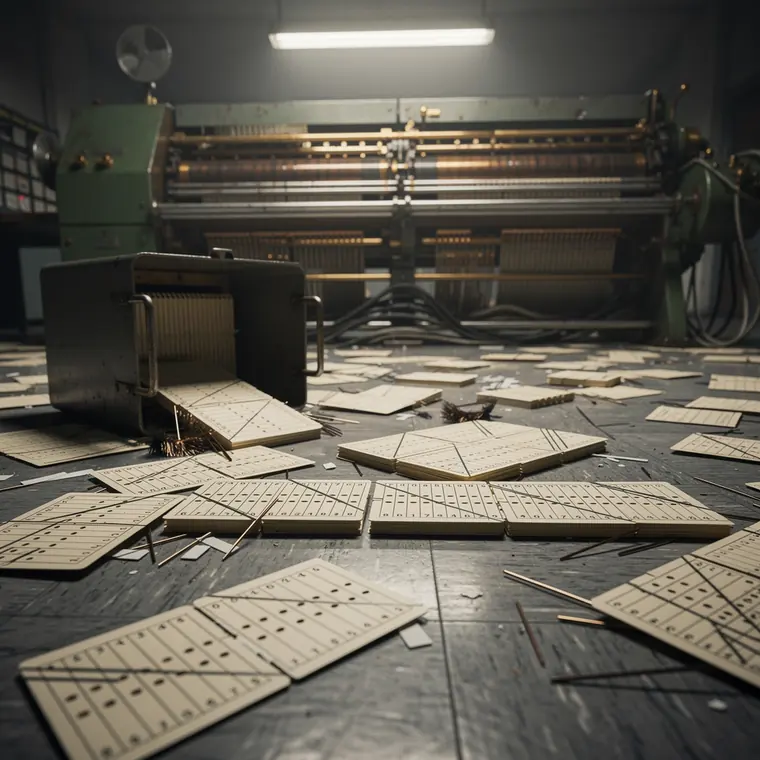
Several thousand punched cards spread across a machine room floor in complete disorder, a few still in loose blocks, an overturned card tray on its side, a diagonal pencil stripe visible across the ends of some blocks, cards with one corner cut ruled into columns with the digits 0 to 9 printed down each column and rectangular holes punched in a scattered pattern, the nearest cards close to the lens on a grey linoleum floor, the scatter receding into soft focus, fluorescent light from above.
- What it was used for
- A deck of cards was a program or a file, and its order was part of the information. When it hit the floor the paper was undamaged; the order was gone. There were two remedies. The first was a number in columns 73 to 80 of every card: Frank da Cruz (Columbia University) writes that most "serious applications (as opposed to student jobs)" punched sequence numbers there. The second was the card sorter, which distributed cards into pockets by the content of one column — "a more common application for the sorter was to put a dropped card deck back in order". Those without sequence numbers, on Peter Grant's account (March 2010), drew diagonal lines with a soft felt-tip pen across the top of the deck.
- What was new
- What was new was not a device but that the cards carried their own recovery with them. Columns 73 to 80 were free because the card readers of the IBM 704, 709, 7090 and 7094 read only 72 columns — so says Russ Holsclaw, a former IBM customer engineer (29 January 2003), who calls the sequence number there "deck-dropping insurance". A weakness of the machine became the space for the insurance. Grant's diagonal line did less than the legend promises: it does not restore the order, it reduces "the number of possible arrangements from n-factorial to something that just might be manageable". And the remedy could itself destroy. Ted Powell (December 2006) retells the familiar story of an operator who dropped a box and sorted it without asking: "Up until that point, the box had contained a sample of random numbers."
What the sources leave open: The year 1950 is not documented: Columbia dates the re-sorting to the 1960s and 1970s; Holsclaw traces the numbers in columns 73 to 80 to the card readers of the 704. No source consulted states how long restoring a deck took. The three eyewitness statements appear as signed, dated reader contributions on the Columbia page, not as the author's own research.