The Tape Cabinet
1958 · Magnetic Tape · Work 596 of 1,871
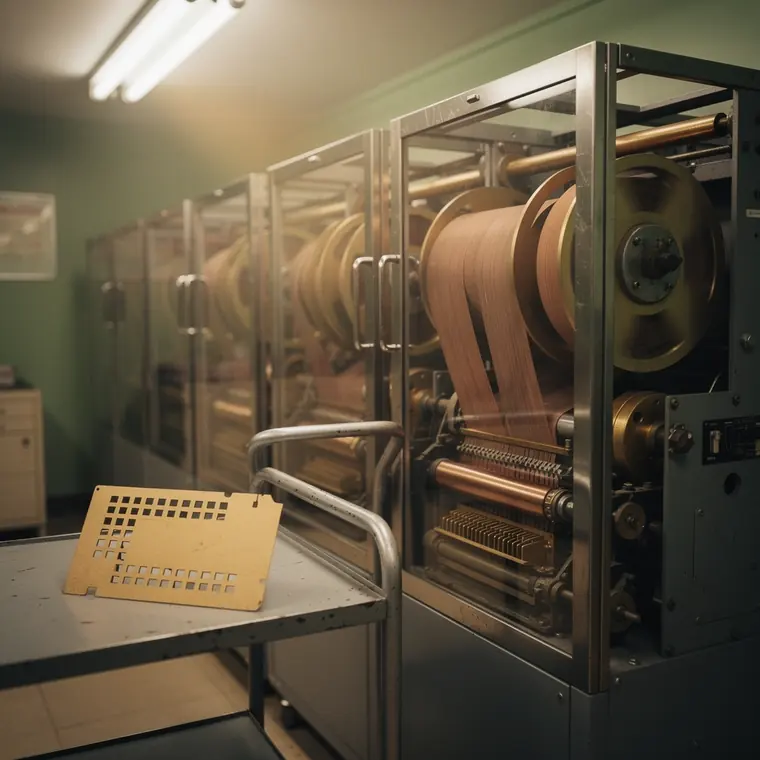
A row of magnetic tape drives with reels turning in short jerks, the tape threading through vacuum columns, a full reel on the nearest drive, a bare card trolley pushed against the wall beside the drives, a stray punched card lying on the trolley close to the lens, a stiff buff card with one corner cut and rectangular holes punched in a scattered pattern, the brown tape and the metal reel hubs catching the light, the drives in grey enamel with glass doors, the row receding into soft focus, a computer room lit by fluorescent tubes.
- What it was used for
- The tape cabinet held what a firm knew. IBM's 1962 reference manual for magnetic tape units describes the reel: 10½ inches across, 2400 feet of tape, a full reel weighing about four pounds and holding "data equivalent to that in 200,000 fully punched IBM cards". Writing density was 200, 556 or 800 characters per inch, at 36, 75 or 112.5 inches of tape per second. With it came an administration: "A tape library may contain a few hundred reels or several thousand reels of magnetic tape" — a librarian, FILE HISTORY and REEL HISTORY forms, a permanent label on every reel, and rules for a machine room that was to be vacuumed every 24 hours and in which smoking was not to be permitted.
- What was new
- What was new was the ratio of volume to space: four pounds of tape for 200,000 cards. Robert Garner and Frederick Dill give a case: "Time-Life transferred 40 million punched card subscriber records to just several hundred magnetic tapes." IBM itself writes that from the early 1950s magnetic tape sped up data processing and "eliminated the need for massive stacks of punched cards as a data storage medium". The barb is double. Tape hit IBM's own business: punched cards accounted, by the company's own history, for "roughly 20% of IBM's revenue and 30% of its bottom line" in the mid-1950s, and Garner and Dill write that IBM's planning team for the 1401 had, before the announcement, "not considered the full impact of the tape option on customers". And a tiny flaw in the tape weighed more than a bent card: in IBM's manual, "small imperfections that result in lost data ... cause an entire series of computations to be repeated".
What the sources leave open: The year 1958 cannot be tied firmly to one tape unit: IBM Archives lists the IBM 729 Model 1 as equipment of the 709 announced on 2 January 1957, while a compilation on Ed Thelen's site dates Model III to about September 1957 and Models II and IV to 30 December 1958. Per-reel capacity figures hold only together with the recording density.
Further reading
- IBM Magnetic Tape Units, Reference Manual, Form A22-6589-1, Juni 1962 (bitsavers)
- Magnetic tape, IBM Heritage
- The punched card, IBM Heritage
- Robert Garner, Frederick Dill, The Legendary IBM 1401 Data Processing System, IEEE Solid-State Circuits Magazine, Winter 2010
- IBM Archives: 709 Data Processing System (Archivfassung)