The Last Punch Room
1975 · Key Punch Operation · Work 598 of 1,871
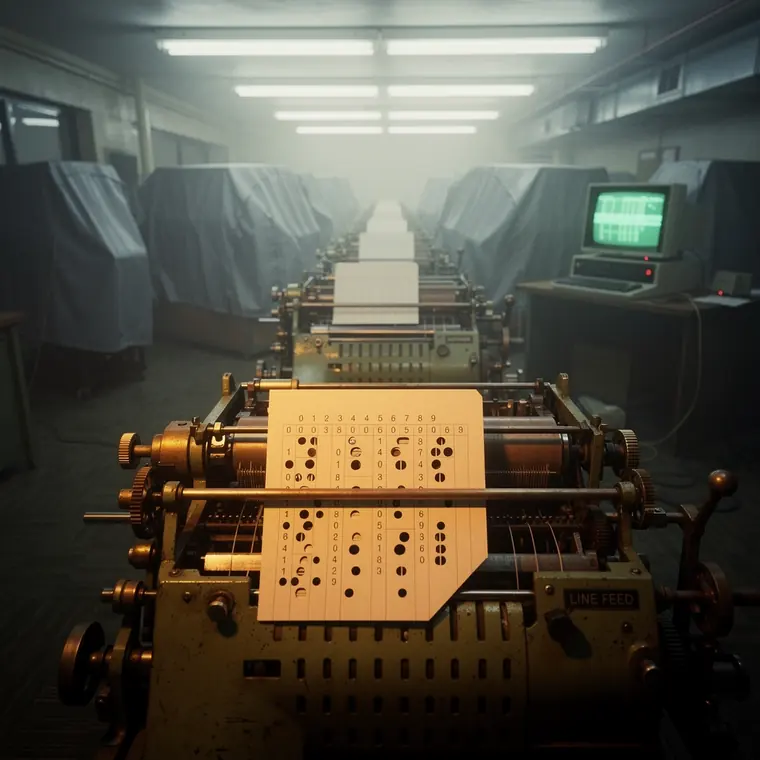
A room of key punches in a row with only two of twenty positions occupied, the operators seen from behind, grey dust covers on the rest, a terminal with a glass screen standing on a desk at the end of the row, the nearest key punch and a card in its bed close to the lens, a stiff buff card with one corner cut, ruled into columns with the digits 0 to 9 printed down each column, rectangular holes punched in a scattered pattern, the row of covered machines receding into soft focus, fluorescent tubes along the ceiling, carpet tiles.
- What it was used for
- The punch room was where paper became data. Operators sat at keypunches turning forms into holes; at verifiers a second person typed the same thing again to find the errors. John W. Rudan writes in his history of computing at Cornell University: "The keypunches and verifiers were typically located in a keypunch room/section." The occupation was large: the Monthly Labor Review of the U.S. Bureau of Labor Statistics records some 295,000 "keypunch operators" for 1978. And the machine was at its end: according to Frank da Cruz (Columbia University), "In 1971, IBM announced its last key punch, the 129".
- What was new
- What was new in these years was not a device but that data entry left the room. The Bureau of Labor Statistics described it in 1985: "These workers are being replaced by terminal operators, many of whom do this work only incidentally to their main functions, for example, airline ticket agents, cashiers, and so forth." Added to that were "optical character recognition equipment and direct sensing equipment". The barb: the work did not disappear, it moved and first of all grew. The same agency counts 520,220 "data entry keyers" in 1999 and 174,930 in 2018, a drop of 66.4 per cent. And the card outlived the punch room: the U.S. General Accounting Office recorded for the 2000 election that "35 percent of the ballots cast came from counties using punch card equipment" — and "49 percent of the uncounted presidential votes were cast on punch card equipment".
What the sources leave open: No date for the end of IBM's card production could be documented; the years 1976 and 1984 in circulation appear only in an anonymous handout without sources. Annual card output in billions could not be documented either. Only 1937 is documented: 32 presses in Endicott and "5 million to 10 million punched cards every day" (IBM).
Further reading
- Michael J. Handel, Growth trends for selected occupations considered at risk from automation, Monthly Labor Review, 13.07.2022 (Tabelle 4)
- Monthly Labor Review, November 1985, Abschnitt Computer occupations (U.S. Bureau of Labor Statistics)
- Max L. Carey, Occupational employment growth through 1990, Monthly Labor Review, August 1981 (Tabelle 2)
- GAO-02-122, Statistical Analysis of Factors That Affected Uncounted Votes in the 2000 Presidential Election, Oktober 2001
- Frank da Cruz, The IBM 029 Key Punch, Columbia University Computing History
- John W. Rudan, The History of Computing at Cornell University, Cornell University, Juni 2005
- The punched card, IBM Heritage