The Card as Bookmark
1980 · Afterlife · Work 599 of 1,871
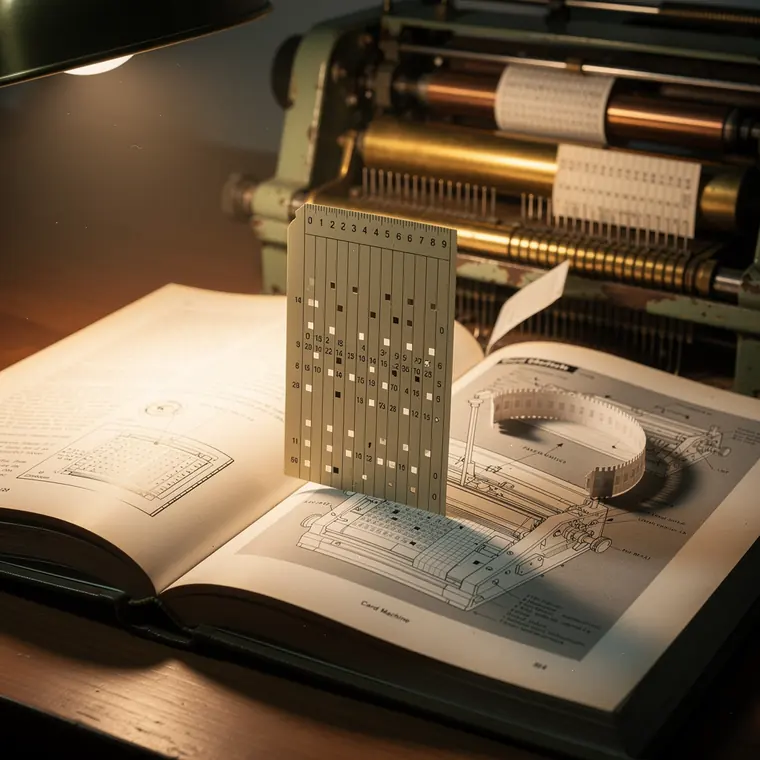
A punched card used to mark a place in a technical manual, a stiff buff card with one corner cut, ruled into columns with the digits 0 to 9 printed down each column, rectangular holes punched in a scattered pattern, its printed column numbers still crisp, the book lying open at the marked page with the card lying across the gutter, the page carrying a line diagram of a card machine, the card close to the lens, the page in soft focus behind it, a desk under a warm reading lamp, the card buff against the grey of the printed page.
- What it was used for
- A punched card was a piece of stiff board, by IBM's own introductory manual 7⅜ by 3¼ inches and ".007 inches in thickness"; the stock was "of controlled quality which must meet rigorous specifications in order to provide strength and long life". The card served as notepaper in daily use and long afterwards. John Walker writes of the cards in his own collection that they were "also the bookmark, notepad, and Post-it ® notes of the programmers who used them on a daily basis". IBM records in its company history that IBM staff jotted notes for their presentations on cards until the early 1990s — long after the firm had stopped selling cards for data processing.
- What was new
- Technically there was nothing new about the second use; what is new is what it means for what survives. Walker states the connection: "It is largely due to these secondary applications that the following punch cards have survived into the present." With the machine, the most famous inscription lost its addressee, and its origin is unsettled — Steven Lubar writes that "the author and origin of the canonical 'Do not fold, spindle, or mutilate' are lost in the mists of time". Earlier printings he documents read differently: at the University of Iowa in the 1930s "Do not fold or bend this card", in an IBM sales brochure of the same decade "Do not fold, tear, or mutilate this card".
What the sources leave open: No museum or archive record describes a surviving card explicitly as a reused bookmark; the evidence is Walker's account of his collection, IBM's company history and Douglas W. Jones's reference to "scratch paper". Lubar's Christmas-tree ornaments made of cards rest, by his own bibliography, on a conversation in 1990, not on a document.
Further reading
- John Walker, Punch Card Gallery, Fourmilab
- Steven Lubar, 'Do Not Fold, Spindle or Mutilate': A Cultural History of the Punch Card, Journal of American Culture (1992)
- The punched card, IBM Heritage
- An Introduction to IBM Punched Card Data Processing, IBM F20-0074 (bitsavers)
- Douglas W. Jones, Punched Cards - A brief illustrated technical history, University of Iowa