The Emperor Takes the Train
1872 · Shimbashi-Yokohama Railway · Work 600 of 1,871
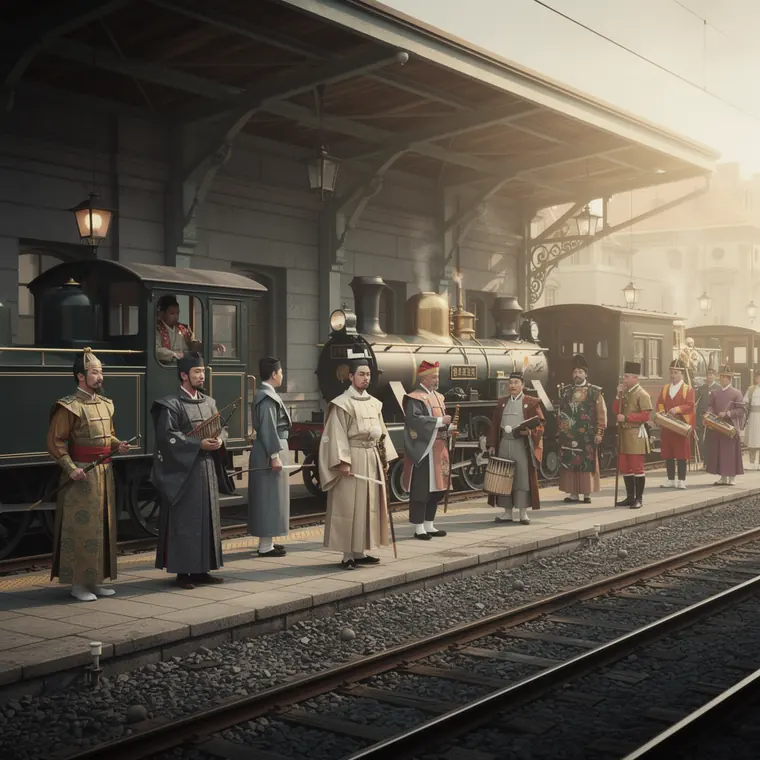
Shimbashi station platform, Tokyo, ten in the morning of 14 October 1872, clear blue sky, low sun from the right, a low gravel platform under a timber roof, plain white paper lanterns under the roof edge, behind it the two-storey station building clad in pale grey tuff stone, a flagpole at the building flying a white flag with one red disc at its centre, small British two-axle carriages on the track, a small dark tank locomotive with plain side tanks far left, at the open door of the third carriage, right of centre, the young man, a Japanese man of twenty in the wide pale silk court robe noshi and a tall black lacquered court cap, face turned toward the camera, the same height and distance from the camera as the courtiers beside him, five court officials in dark hitatare robes of deep blue, brown and grey around him, seen from behind and in profile, guardsmen in dark western uniforms with white cross belts presenting rifles along the platform edge, a bugler at the end of their line, court musicians in white robes by the building, three envoys in black frock coats and top hats.
- Who
- The Meiji Emperor (1852–1912), personal name Mutsuhito, was the 122nd emperor of Japan. He came to the throne in 1867 as a youth. In the same year the shogun gave up power, and a new government led by men from Satsuma and Chōshū ruled in his name from then on. Under him Japan abolished feudal rule, adopted institutions and technology from Europe and America, and in 1889 received a constitution that gave the emperor wide powers. He often mediated in disputes between the leading politicians, and in the wars he took part in their direction at Imperial Headquarters. His reign has a dark side: Japan went to war with China (1894–95) and Russia (1904–05), annexed Korea in 1910 and became a colonial power. The Imperial Rescript on Education of 1890 put loyalty to the emperor at the centre of schooling. The era bears his name, and the Meiji Shrine in Tokyo is dedicated to him.
- The moment
- On 14 October 1872 the Emperor opened Japan's first railway, 29 kilometres from Shimbashi in Tokyo to Yokohama. The records of the Council of State and the Railway Bureau set out the course of the day. At nine o'clock he left the palace in a four-horse carriage, dressed in the court robe noshi. At Shimbashi station the guard presented arms, a bugle sounded, the national flag was raised and court musicians played. The Emperor boarded the third carriage, and at ten the train departed; on the Hibiya parade ground the guard artillery fired a 101-gun salute, and the warships off Shinagawa fired 21. At eleven he reached Yokohama. There he sat down on a chair in the rest room and proclaimed a rescript: he had opened the line himself, rejoiced in its benefit, and wished it to spread across the whole country. Locomotives, carriages and rails came from Britain. The picture shows Shimbashi before departure: the Emperor at the door of the third carriage, officials in old dress around him, the guard along the platform edge.
- The other side
- At the opening the officials wore hitatare, the old ceremonial dress of the samurai, and the Emperor wore the court robe. About two months later, in December 1872, a decree of the Council of State abolished the hitatare and introduced Western court uniforms. The machine of the new Japan was opened in the dress of the old. And it was expensive: third class cost 37.5 sen, while ten kilograms of rice cost about 55 sen at the time. Even the reduced fares of 1873 were beyond the means of most people.
What the sources leave open: Which of the ten British locomotives hauled the train is disputed; in the picture the engine carries neither number nor plate. The colour of the court robe is not recorded, nor whether the Emperor stood on the platform. The station plans are lost; building and roof in the picture are a typification. The face follows Uchida Kuichi's photograph of April 1872.
Further reading
Sources
- Kotobank: 明治天皇 (Nihon Daihyakka Zensho, Sekai Daihyakka Jiten, Yamakawa Nihonshi Shōjiten, Britannica Kokusai Daihyakka Jiten)
- Nationalarchiv Japan: 日本最初の鉄道 新橋横浜間鉄道開業 (太政類典, Ablauf, Salut, Erlass)
- Business Insider Japan: 150年前、鉄道開業の日に走った汽車に誰が乗っていた? (nach 鉄道寮事務簿 Bd. 6: Nōshi, Vierspänner, dritter Wagen)
- Mynavi News: 鉄道トリビア 224 (Sitzordnung, Kaiser im dritten Wagen)
- Bezirk Minato: 鉄道開業150年 港区と鉄道の夜明け (29 km, 53 Minuten, 9 Zugpaare, Fahrpreise, Reispreis, britische Einfuhr)
- nippon.com: Express Train to Industrialization (Beamte in Hitatare, Fahrpreise 1873)
- National Diet Library: 大礼服の制定 (Erlass 大礼服及通常礼服ヲ定メ衣冠ヲ祭服ト為シ直垂狩衣上下等ヲ廃ス, sieben Tage nach der Audienz der Iwakura-Mission bei Königin Victoria)
- LSE STICERD: The Iwakura Mission in Britain, 1872 (Audienz bei Königin Victoria Anfang Dezember 1872)