Mercury Delay Line
1947 · Acoustic Delay Storage · Work 601 of 1,871
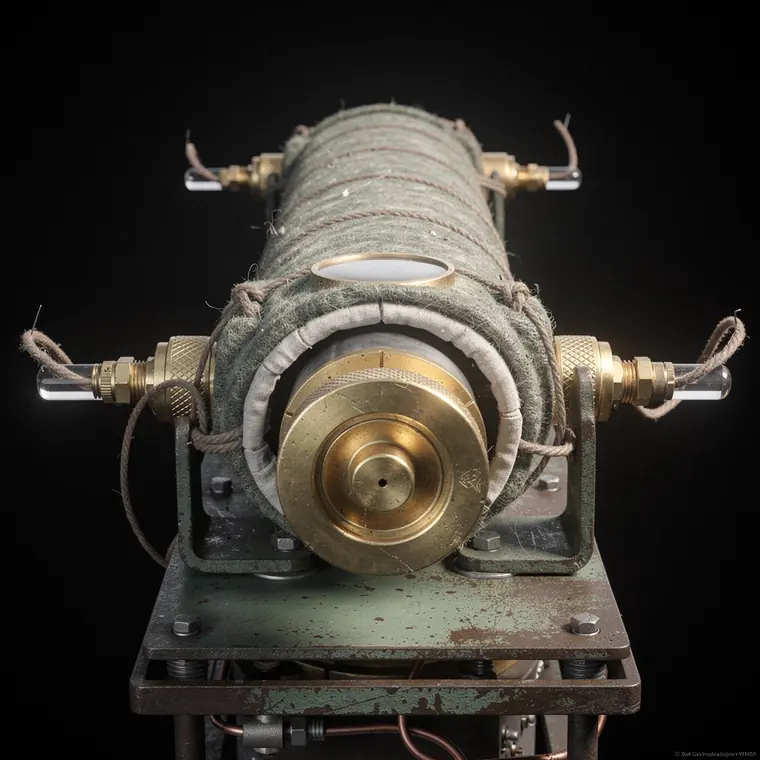
A long sealed steel tube of mercury lying horizontally, wrapped in a thick lagged jacket of felt and cloth bound with cord, a quartz crystal transducer clamped in a brass fitting at each end with its lead brought out through a threaded gland, a small round inspection window in the jacket showing the mercury surface within as a dull silver mirror, the tube resting in two cast cradles on a plain metal chassis, seen close so the tube and its end fittings fill the frame, a single soft light from behind the far end grazing the brass fittings warm against the grey lagging, the tube standing alone against pure black.
- What it was used for
- A mercury delay line was a steel tube full of mercury with a quartz crystal at each end. One crystal drove the bits into the mercury as sound pulses, the other picked them up again; because sound travels through it at only about 1,450 metres a second, the travel time was the store. At Cambridge the EDSAC's main store consisted, according to the Computer Laboratory, of "32 tanks", each "about 5 ft long", each holding 32 numbers of 17 binary digits, "one being a sign digit", giving "1024 storage locations in all" at a 500 kHz clock. The UNIVAC I had seven tanks of 18 channels each for 1,000 words. What that weighed is on the Computer History Museum's label: "Each tube weighed nearly 800 lbs when filled with mercury" — and a set of these structures with their electronics gave the machine "a memory of about 1.5 KB".
- What was new
- What was new was not the delay line but the feedback that turned it into a store. The line came from radar; the Computer History Museum puts it this way: "Advances in radar during World War II had an unanticipated spinoff: delay lines as computer memory." J. Presper Eckert and John W. Mauchly filed the patent "Memory system" on 31 October 1947; it was granted on 24 February 1953. The 1949 paper by Auerbach, Eckert, Shaw and Sheppard records two priorities for Eckert: "Eckert was the first to use mercury as the acoustic medium and the first to use nonreflective backings on the quartz crystal transducers" — and in the same section the authors name predecessors, the Scophony television system and work by Shockley at Bell Telephone Laboratories, whose lines were not regenerative. The barb is in the patent itself: mercury is merely the preferred liquid there, and "other liquids may be used for the transmission of the acoustic waves".
What the sources leave open: No source consulted states how much mercury an EDSAC tank held; only the total weight of a filled UNIVAC tube is documented. On EDSAC word length Cambridge gives 17 bits per short word; two adjacent locations together hold a number of 35 bits including the sign.
Further reading
- Some EDSAC statistics, University of Cambridge Computer Laboratory
- Delay Lines, CHM Revolution, Computer History Museum
- US-Patent 2,629,827, Memory system, Eckert und Mauchly, angemeldet 31.10.1947, erteilt 24.02.1953
- Auerbach, Eckert, Shaw, Sheppard, Mercury Delay Line Memory Using a Pulse Rate of Several Megacycles, Proceedings of the I.R.E., August 1949
- Liquids - Speed of Sound, Engineering ToolBox
- UNIVAC I mercury memory tank, CHM Revolution, Computer History Museum
- Ed Thelen, UNIVAC I Mercury Delay Line Memory (Auszug UNIVAC I Maintenance Manual)