The Magnetostrictive Line
1951 · Nickel Wire Delay · Work 605 of 1,871
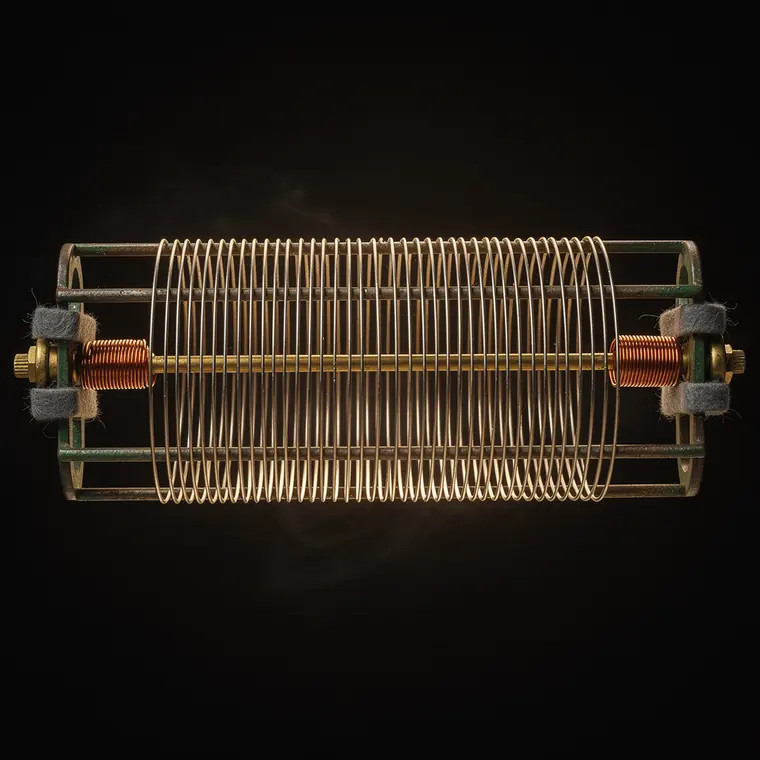
A long fine nickel wire coiled loosely around a rectangular open frame like a skein of yarn, many turns spaced evenly along the frame, a small coil of enamelled copper wire wound around the nickel wire at each end where it enters and leaves, small pads of grey felt clamping the wire at each end as dampers, the frame of plain bare metal, seen close so the coiled wire and its damping pads fill the frame, a single soft light from behind picking out each turn of the nickel wire as a thin bright line, the frame alone against pure black.
- What it was used for
- Here nickel wire took the place of the mercury tank. Nickel changes length in a magnetic field, and that is enough to strike a sound pulse into a wire and turn it back into current at the far end. It was developed at Elliott Brothers in Borehamwood and published in October 1951 (R. Millership, R. C. Robbins, A. E. De Barr, British Journal of Applied Physics 2, p. 304). The first computer to use it was Elliott's "Nicholas": on the Computer Conservation Society's account it was designed in early 1952 and completed in December 1952, and only one was built. Its main store held 1,024 words of 32 bits in 64 long lines, with five short 32-bit lines as registers, at a digit period of three microseconds. Each line was a loosely coiled spiral of nickel wire above an 18-inch square aluminium plate; 65 such plates stood in a cabinet about six feet high.
- What was new
- What was new was a delay-line store made of wire: no mercury, no heated steel tank. The Computer Conservation Society puts the comparison soberly: "Nickel delay lines were more robust and cheaper per bit than the mercury delay line technology" — but against cathode-ray tube storage "more robust and more reliable ... but more expensive per bit". The barb is in the description of Nicholas: the 65th line stores nothing. It controls a master oscillator "in order to minimise the effects of temperature variations on the effective time-delay of the memory lines". Temperature control had not been abolished but had moved from the heating jacket into a control loop. And thrift had its price: grouping the lines into loops saves circuitry and costs time — the average access time is 64 word-times instead of the possible eight.
What the sources leave open: 1951 is the year of publication, not of use; the first computer with nickel lines was finished in December 1952. None of the documents consulted gives the length of the Elliott wires. On the Ferranti Pegasus the Computer Conservation Society contradicts itself: one document says "steel wire acoustic delay lines", its glossary a "nickel delay line". The 1951 paper sat behind a paywall.
Further reading
- Systems architectures of the Elliott 152, 153 and Nicholas computers, CCS-E1X2, Computer Conservation Society
- Delivery lists and applications of the Elliott 152, 153 and Nicholas computers, CCS-E1X1, Version 3, November 2011
- Glossary, Our Computer Heritage, Computer Conservation Society
- P. F. Linington, Constructing and Testing a Replica Store for the EDSAC, in: Making IT Work (CCS/BCS), 2017
- R. Millership, R. C. Robbins, A. E. De Barr, Magnetostriction storage systems for a high speed digital computer, Br. J. Appl. Phys. 2 (10), Oktober 1951, S. 304