Williams-Kilburn Tube
1947 · Electrostatic Storage · Work 607 of 1,871
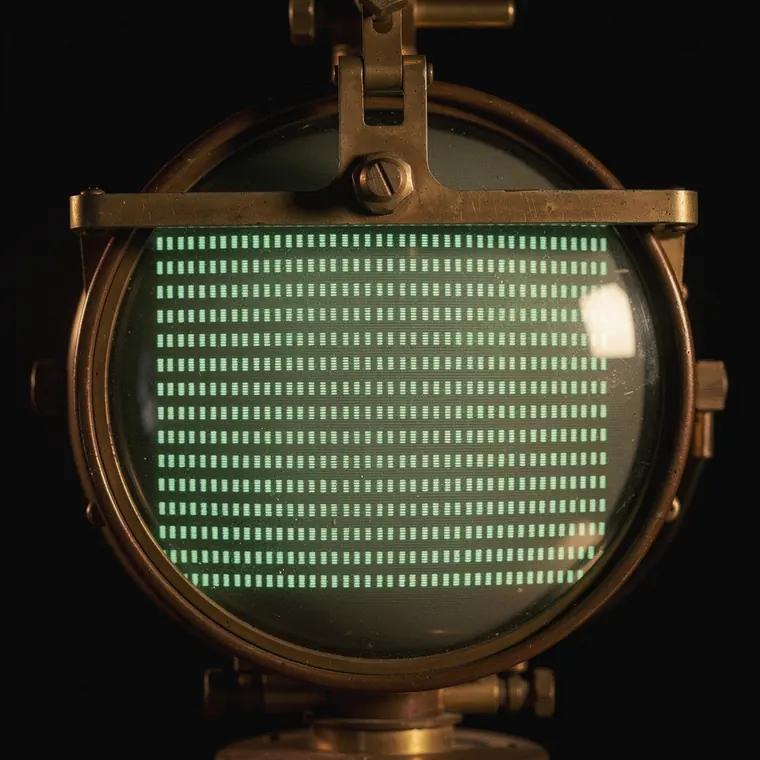
The glass face of a cathode ray tube carrying a rectangular grid of small bright green dots and dashes in even rows, a thin metal pickup plate held close against the outside of the glass by a plain clamp, the pattern faintly uneven where the charge has begun to fade, the rows blurring slightly toward the edges of the raster, the phosphor glow the sole light on the glass, the round tube face filling the frame, the glass rim catching a faint warm reflection, everything beyond the tube face falling into pure black.
- What it was used for
- The Williams-Kilburn tube was a working store built from an ordinary cathode ray tube. Bits sat as patches of charge on the phosphor screen, and a metal plate outside the glass read them. Freddie Williams began the work at the Telecommunications Research Establishment after a trip to the United States in June 1946; by November 1946 he could hold a single bit. Tom Kilburn found a better method in March 1947, and by November 1947 the two held 2048 bits for a period of hours. The store carried the Manchester machines and was later built into the IBM 701 and 702 as well. It used standard components, was small and cheap, and needed neither temperature control nor closely regulated power.
- What was new
- What was new was not the tube but fast random access. The competing store, the mercury delay line, had been chosen for EDVAC, EDSAC and ACE; there you waited until the word you wanted came round. Here any spot could be addressed at once. Williams and Kilburn were not alone in this: from 1946 Jan Rajchman at RCA designed the Selectron on the same electrostatic idea, but with bit selection forced by wires rather than painted on a screen. The price of the Manchester route: the charge decayed within tenths of a second, so the store had to rewrite itself continuously, and the pick-up plate covered the screen, so the contents could only be seen on a second tube. Around 1955 core memory pushed the tube out of new installations - less than ten years after the first stored bit.