Selectron Tube
1948 · Selectron Storage · Work 610 of 1,871
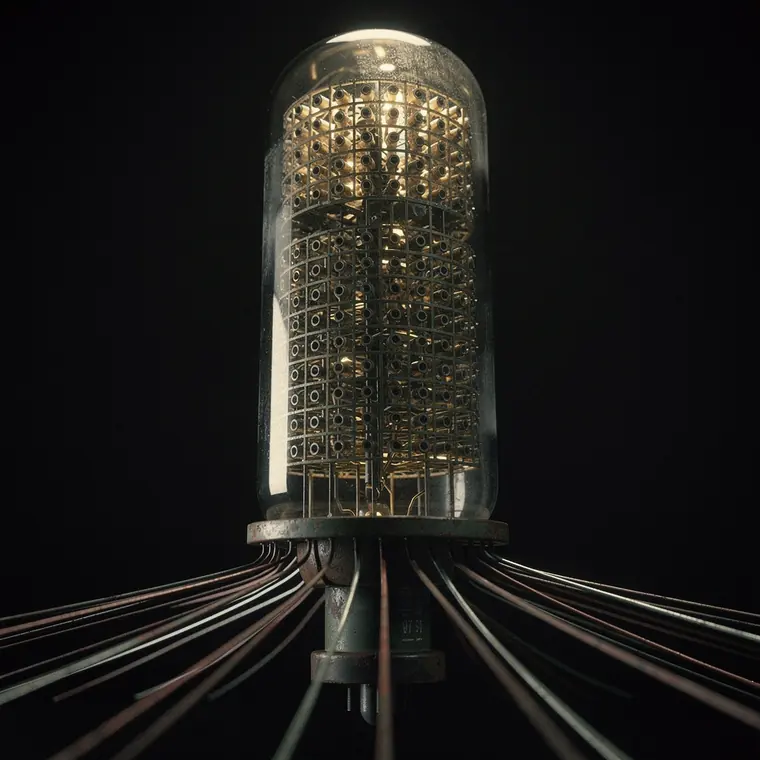
A tall glass vacuum tube standing upright, inside it a precise rectangular array of small metal eyelets held in a grid of fine bars, the eyelets catching light in even rows, wire leads fanning out from the base in a wide skirt into a plain circular base, the glass envelope clear and slightly reflective, the internal grid filling the frame, a single soft light from behind the tube passing through the glass and glinting off each row of eyelets, warm metal against grey glass, the tube alone against pure black.
- What it was used for
- The Selectron was RCA's design for an electrostatic store, intended as the main memory of the IAS computer at Princeton. Jan Rajchman presented it on 23 August 1946 in a lecture at the Moore School: a cylindrical vacuum tube, five inches high and three inches across according to a later reprint, with a cathode along its axis. Sixty-four straight and sixty-five circular wires selected 4096 bit positions, and a single bit was to be read and written in a few microseconds. Rajchman's US patent 2,494,670 was filed on 26 April 1946 and issued on 17 January 1950. What was finally built and used was a smaller version holding 256 bits, in the RAND Corporation's JOHNNIAC.
- What was new
- Rajchman did not want the selection of a bit to depend on a charge pattern on a screen; he wanted it forced by wires. Every bit position lay in a window of the wire grid and was fixed by construction, not merely hit by a deflection voltage. That promised predictable behaviour instead of the Williams tube's moods - and at the same time made the tube hard to build. The 1946 progress report called selection and construction solved, but not the stability of the stored charge, in particular unwanted interaction between positions. Two hundred tubes were planned by the end of 1946. In spring 1948 there were still none, and the IAS machine the Selectron had been designed for fell back on 40 Williams tubes in parallel. The Selectron went into service only in 1953, with 256 bits instead of 4096, in a different computer.
What the sources leave open: The Manchester page gives the 1946 lecture only as a summary; the dimensions come from the answers to questions recorded in the 1985 reprint, not from the lecture text. Rajchman's own papers of 1947, 1949 and 1951 are available as scans on rcaselectron.com. None of the sources consulted gives a number of Selectron tubes actually built.