The Magnetic Drum
1948 · Rotating Magnetic Storage · Work 612 of 1,871
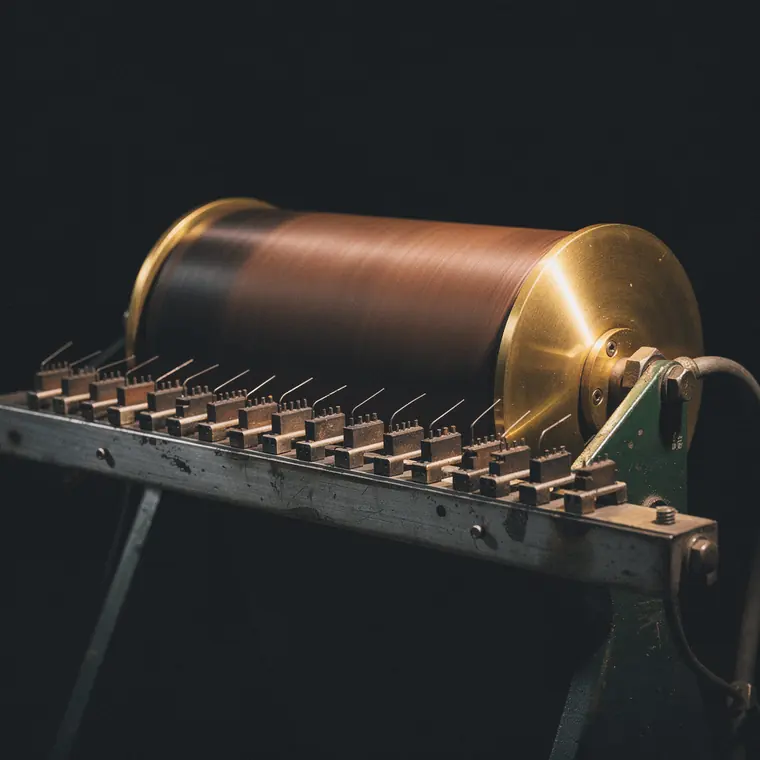
A heavy brass cylinder mounted horizontally, its surface coated with a dull brown-black oxide film, spinning so fast that its surface blurs into a smooth band, a comb of read heads mounted in a straight row along its length on a plain steel bar, each head a small block with a fine wire lead, the gap between the heads and the drum surface thinner than a hair, the drum end plate turned bright brass, seen close so the drum and its comb of heads fill the frame, a single soft light from behind the drum silhouetting the row of heads, deep black behind.
- What it was used for
- The magnetic drum was a rotating cylinder with a magnetisable coating, surrounded by fixed read-write heads, one set per track. Nothing moved but the drum, and the longest wait was one revolution. Drums of this kind were built at Engineering Research Associates in St Paul for the US Navy's codebreakers. According to the account by the naval officer David Boslaugh, the Bureau of Ships had issued a contract as early as 1946 to investigate binary storage on rotating magnetic drums. ERA first tried iron particles in glue, then recording tape glued to the cylinder, whose ends curled up; what worked best was a magnetic liquid from 3M, sprayed on like paint. In 1948 ERA delivered two working drums.
- What was new
- The step taken in 1948 was not a new body but a circuit: ERA engineers devised circuitry that allowed single places on the running drum to be erased and rewritten. Before that, writing meant sacrificing the whole contents - which made the drum a tape running in a circle; afterwards it was a store. Who had the drum first cannot be decided: Gustav Tauschek patented an early, non-rotating design in 1932, Andrew Donald Booth devised an experimental drum store in London around 1946, and the VIP Club names Arnold Cohen and Sid Rubens as the patent holders of the rotating drum. The catch remained the revolution. How fast a machine ran depended on where the next instruction lay on the drum. On the later IBM 650 a program of its own, SOAP, placed instructions so that they arrived under the head in time.
What the sources leave open: On the early history of the drum the sources consulted name different people without expressly contradicting one another: Tauschek in 1932 (Computer History Museum), Booth in London (Science Museum, only for this experimental unit of about 1946, with no capacity given), and Cohen and Rubens (VIP Club, a site run by Univac veterans). None of them gives patent numbers for Booth or for Cohen and Rubens.
Further reading
- David L. Boslaugh: The Navy Codebreakers and Their Digital Computers (First-Hand, Engineering and Technology History Wiki)
- Magnetic Drums (Computer History Museum, Revolution)
- Experimental magnetic drum store (Science Museum Group Collection, 1959-180)
- Magnetic Data Storage - The Early Days (Computer History Displays, University of Auckland)
- Memory Engineering, Chapter 45 (VIP Club, Lowell A. Benson u. a.)