ERA 1101 Drum
1950 · Drum Memory · Work 613 of 1,871
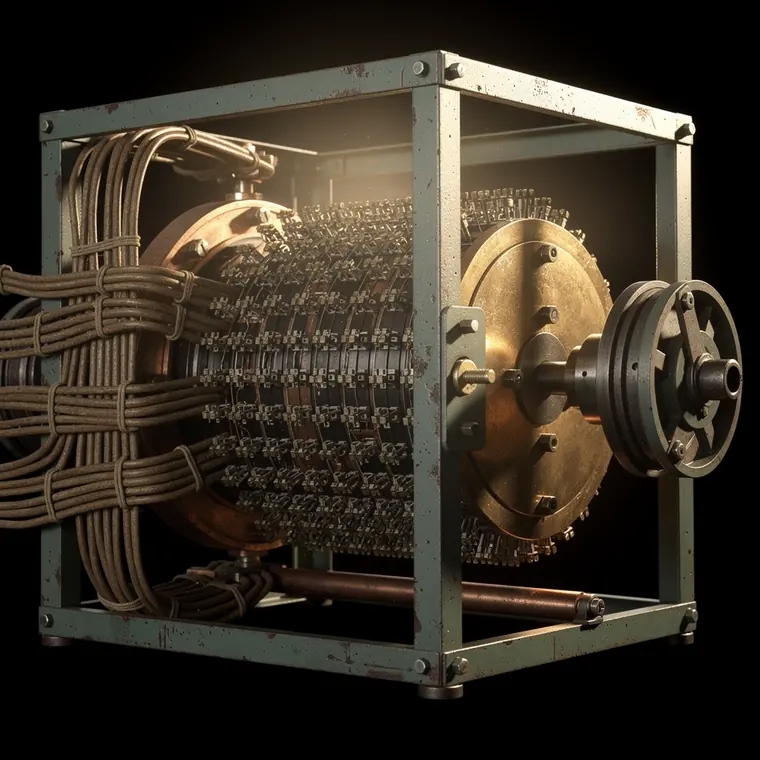
A large magnetic drum in an open steel frame, the drum surface dark oxide, hundreds of read heads mounted around it in even rows, their leads gathered into neatly laced cable looms bound with waxed cord and running away to the left, the drum's end plate carrying a small balance weight bolted off centre, machined steel bearing housings at each end, seen close so the drum and the laced looms fill the frame, a single soft light from behind the frame catching the brass and steel edges warm against grey, the whole standing alone in pure black.
- What it was used for
- The drum of the Atlas computer was the first drum by Engineering Research Associates to serve a computer as main memory. It was 8.5 inches in diameter and 14 inches long, held 16,384 words of 24 bits at 80 bits per inch, ran at 3,450 revolutions per minute and took 17 milliseconds to reach data. Atlas was not a commercial product but contract work for the US Navy's codebreakers, built by Engineering Research Associates under the contract "Task 13"; the Navy authorised construction in March 1948. The machine had 2,700 valves and 2,385 crystal diodes, weighed 17,400 pounds and occupied 400 square feet. It went to the CSAW establishment in Washington in December 1950.
- What was new
- What was new was the role, not the component. Drums had existed for years as an accessory; here the whole computer hung on one, with everything that implies. The contents survived switch-off but cost half a revolution of waiting on average, and 16,384 words was a great deal of room for 1950, at a price paid in milliseconds. The catch is in the name. The commercial designation 1101 is binary for 13, the number of the Navy task - the machine carried its classified contract number openly in its product name. It did not sell even so: according to Boslaugh, ERA built only one commercial 1101, used it in its own offices and found no buyer. The money came later, with the 1103 derived from Atlas II.
What the sources leave open: The sources differ on the delivery date: Boslaugh gives December 1950, the VIP Club chapter October 1950. The drum figures come from the University of Auckland display page, which cites no individual references; of these, Boslaugh confirms only the 16,384 words of 24 bits. That the only commercial 1101 found no buyer is Boslaugh's statement; Cohen recalls that it went to Georgia Tech as a donation or a bargain sale.
Further reading
- David L. Boslaugh: The Navy Codebreakers and Their Digital Computers (First-Hand, Engineering and Technology History Wiki)
- Magnetic Data Storage - The Early Days (Computer History Displays, University of Auckland)
- Oral history interview with Arnold A. Cohen, OH 58 (Charles Babbage Institute, University of Minnesota)
- Memory Engineering, Chapter 45 (VIP Club, Lowell A. Benson u. a.)