The Head Assembly
1950 · Read-Write Head · Work 614 of 1,871
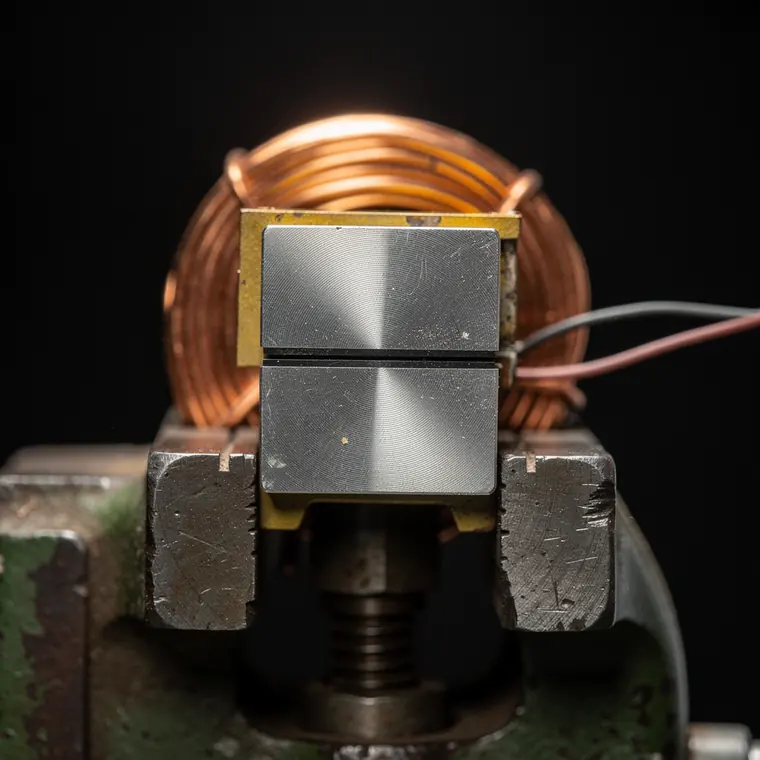
A single magnetic read-write head removed from its mounting and held in the jaws of a small bench vice, the pole face laminated and polished, its gap visible as a hairline across the polished face, a coil of fine enamelled copper wire wound behind the pole piece, two thin leads trailing from the coil, the vice jaws of plain steel, seen in extreme close-up so the pole face and the hairline gap fill the frame, a single soft light from behind grazing the copper windings warm against the grey steel, everything else falling into pure black.
- What it was used for
- The head assembly was the frame that carried the read-write heads around the drum. The heads were staggered around the cylinder, one set per track, and did not move; so all mechanical positioning fell away and the longest access time was one revolution. Several heads could read at once, so a whole word was transferred in parallel. How densely such a set could be packed is shown by a Remington Rand drum of type 1124G1 measured by Larry Bolton in the VIP Club chapter: 133 data tracks and 133 data heads, 16 tracks per inch along the drum and 80 bits per inch around its circumference, with a drum diameter of 4 3/8 inches.
- What was new
- The innovation lies in what was left out. Because no head had to travel, all positioning mechanics fell away, and the longest access time was fixed: one revolution. In exchange, the limit of the store moved from the electronics into precision mechanics. More capacity now meant fitting in more heads, closer together, each held at an unchanging distance from the surface. What was at stake is shown by an item in the Computer History Museum's collection: the drum surface is scratched by misaligned heads.
What the sources leave open: For the head assemblies of around 1950 themselves, none of the sources consulted gives the gap between head and drum surface or a head count. The figures for the 1124G1 unit come from the VIP Club chapter, a site written by Univac veterans; it gives no year of manufacture, so the unit cannot be firmly placed in 1950. Bolton says its heads and their mounting are a variant not seen in any photo of other drums of the period.
Connections
Every connection names its kind. “Forerunner” on its own would be a claim.
- Works withERA 1101 Drum1950The drum turns, the heads stand still: one head per track, "staggered around the drum". ERA's first drum for a computer, delivered in 1950 for the Atlas and sold as the ERA 1101, held 16384 words of 24 bits at a density of 80 bits per inch along the track.Source: Magnetic Data Storage: The Early Days - Department of Computer Science, University of Auckland