The Flying Head
1956 · Air Bearing · Work 616 of 1,871
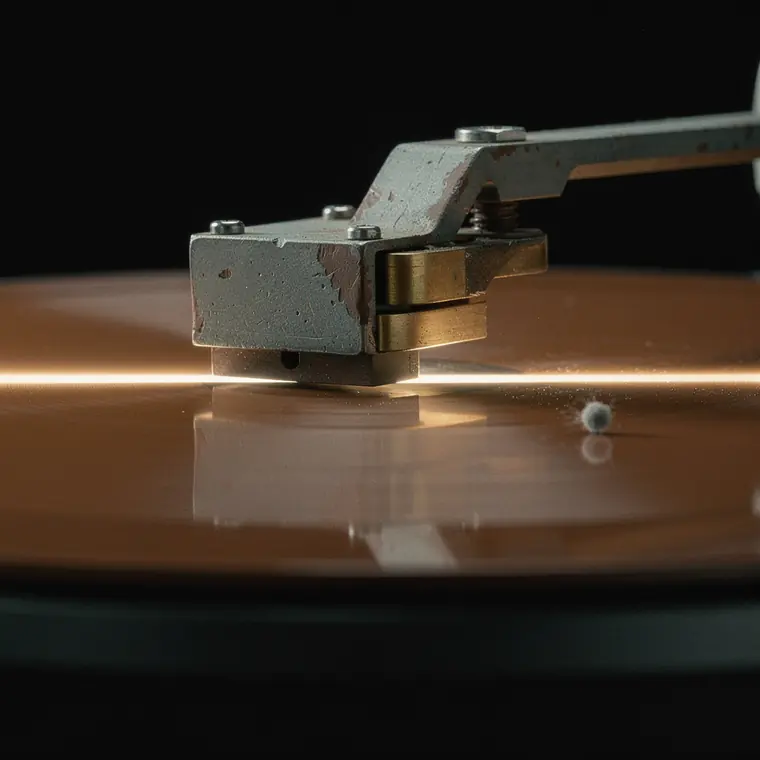
A small magnetic head riding on a cushion of air a fraction of a hair above a spinning disk platter, seen exactly edge on, the gap between head and platter a thin bright line, a single fine dust particle sitting on the platter surface further out and dwarfed by the head, the platter surface brown magnetic oxide with a mirror-like polish, the head block of plain metal with a hair-thin air outlet, extreme close-up so the head and the sliver of gap fill the frame, a single soft light from behind shining through the gap, the platter surface fading into pure black.
- What it was used for
- The head of the IBM 350 did not touch the disk; it floated on a cushion of air. Hoagland calls it an ingeniously designed pressurised air-bearing slider; the air came from a compressor of its own, weighing 441 pounds. According to the Computer History Museum this cushion held the head about 800 millionths of an inch above the surface. That was the condition for one head to pass over the same track again and again without wearing the coating away - at 1,200 revolutions per minute and a disk of 24 inches, a point on the rim of the disk travels at roughly 86 miles per hour.
- What was new
- The head of 1956 did not fly; it was carried. The air came from outside, from a compressor; a slider that generates its own cushion from the air dragged along by the disk became established only with the IBM 1301. That drive was announced in 1961 and shipped in 1962, did away with the compressed-air plant and cut the average spacing from 800 to 250 millionths of an inch - only then did tracks narrow and disks grow denser. The idea itself is older than either: according to the Computer History Museum, Jake Hagopian described it in 1954, and his patent was filed on 14 May 1956 and issued on 31 October 1961. "Flying head" and "1956" therefore coincide only if one means the filing date, not the machine.
What the sources leave open: The figure of 800 millionths of an inch comes from the Computer History Museum; Hoagland gives a figure at this point whose unit is unreadable in the retrieved text, so it is not cited here for the spacing. The rim speed is calculated from 24 inches and 1,200 revolutions per minute, not taken from a source. The museum names flying heads before the 1301 on the Stretch drive 353 and at Bryant; Hoagland gives the Stretch drive pressurised air heads.
Connections
Every connection names its kind. “Forerunner” on its own would be a claim.
- Works withIBM 350 Disk Stack1956The head never touches the disk: "The spacing of the heads from the disk is maintained by an air bearing", fed by minute air jets in an annular manifold around the magnetic elements, at a gap of a thousandth of an inch. Across the stack of 50 disks turning at 1200 rpm, "there is never physical contact between the heads and the magnetic coating".Source: Noyes & Dickinson, The Random-Access Memory Accounting Machine. II. The Magnetic-Disk, Random-Access Memory, IBM Journal of Research and Development 1957 (ETHW)
Further reading
- 1961: Flying heads improve HDD capacity and speed (Computer History Museum, Storage Engine)
- 1956: First commercial hard disk drive shipped (Computer History Museum, Storage Engine)
- A. S. Hoagland: History of Magnetic Disk Storage Based on Perpendicular Magnetic Recording, IEEE Transactions on Magnetics 39(4), Juli 2003, S. 1871-1875