The Bead
1952 · Ferrite Core · Work 618 of 1,871
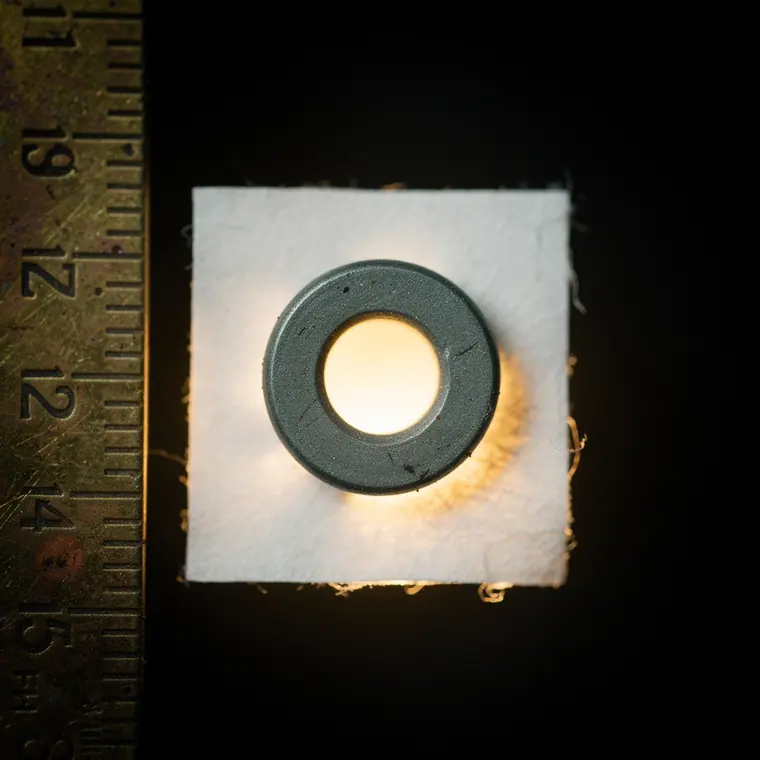
One ferrite ring the size of a pinhead resting on a small scrap of plain white paper, its surface matte grey-black with a faint sintered texture, the hole through its centre clean and round, its edges slightly rounded, extreme close-up so the ring fills the frame, soft light from behind the paper passing through the hole and glowing through the paper fibres, the white of the paper falling away into pure black at the edges.
- What it was used for
- The core was a ring of ferrite, a magnetic ceramic, and carried exactly one bit: magnetised one way a zero, the other way a one. Early cores measured one sixteenth of an inch across, according to the Computer History Museum, with a hole about the width of a pencil lead. Through that hole ran the wires that switched the ring and interrogated its state. The memory of MIT's Memory Test Computer, a plane of which the MIT Museum keeps, held more than 1,000 such rings, and a value was stored or retrieved in less than eight millionths of a second.
- What was new
- With the ring, memory stopped being a process and became an object. Whirlwind's tube store was slow and unreliable; the core kept its magnetisation with no power and no attention. In exchange the cost moved from the circuit into the piece count: a bit cost about one dollar at first, according to the Computer History Museum, and every one of them had to be threaded by hand. Only the later cores were four times smaller, ten times faster and a hundred times cheaper. How small the cores became is shown by a joke the museum passes on: that new cores were made from the holes punched out of the previous generation.
What the sources leave open: No source consulted dates a development step on the core itself to 1952. What is firmly dated is Forrester's patent filing of May 1951 and the installation in Whirlwind on 8 August 1953. On the composition of the ferrite and the makers of the early cores, no reliable source was found.
Further reading
- Magnetic Core Memory (Computer History Museum, Revolution)
- Ferrite core for Whirlwind I computer memory (MIT Museum, Objekt IN-0902)
- 1953: Whirlwind computer debuts core memory (Computer History Museum, Storage Engine)
- Magnetic-Core Memory (Engineering and Technology History Wiki)
- Core Memory (Computermuseum, Universiteit van Amsterdam)