The First Core Plane
1951 · Coincident Current Memory · Work 619 of 1,871
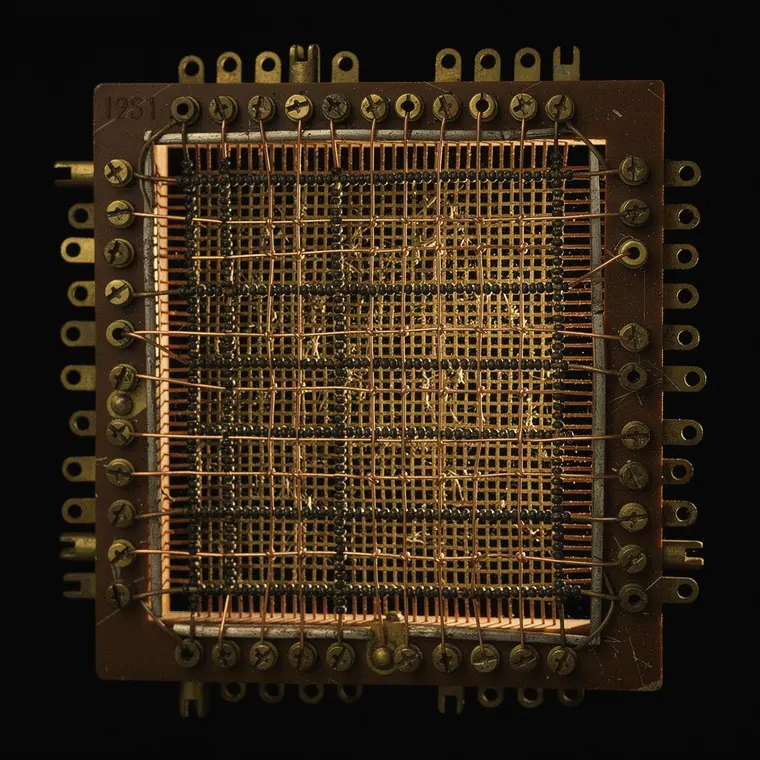
A small square frame strung with a regular grid of fine copper wires, tiny ferrite rings threaded where the wires cross, the weave slightly uneven, some rings tilted and some rows a little out of line as made by hand for the first time, the frame of plain bakelite with brass terminals along its edges, the grid filling the frame edge to edge, soft backlight coming through the matrix so each wire glows as a fine bright line and each ring stands as a dark bead, the plane alone against pure black.
- What it was used for
- A core plane was a grid of wires with one ferrite ring at every crossing point. The Whirlwind plane kept at the Smithsonian, made at MIT's Lincoln Laboratory, carries 1,024 cores threaded by 32 vertical and 32 horizontal address wires and one diagonal sense wire; the frame measures about 23.5 by 26 centimetres. Addressing worked by coinciding currents: the vertical and the horizontal wire each carry half the current needed to flip a ring. Only the core at the crossing receives both halves and switches. This was needed for Whirlwind, an air-defence computer whose tube store had proved too slow and too fragile.
- What was new
- What was new was the arithmetic: for n by n bits, n plus n wires suffice, because the address is not switched but added. Who invented core memory is disputed, and settling it was costly: Frederick Viehe filed in 1947, An Wang in 1949, Jan Rajchman in 1950, Jay Forrester in 1951, whose notebook entry on the coincident-current method is dated 13 June 1949. In 1955 IBM bought Wang's rights for $500,000 and in 1964 paid MIT $13 million for Forrester's patent - the largest patent settlement to that date, according to the Computer History Museum.
What the sources leave open: For the year 1951 no source was found that dates a finished core plane. Documented for 1951 are Forrester's patent filing in May and his paper on three-dimensional core storage in the Journal of Applied Physics. The first plane working in a computer was installed in Whirlwind on 8 August 1953. The Smithsonian object is undated; the page places the development in the late 1940s and early 1950s.
Further reading
- Mainframe Computer Component, Whirlwind Magnetic Core Memory Plane (Smithsonian National Museum of American History, 1987.0818.05)
- Magnetic Core Memory (Computer History Museum, Revolution)
- 1953: Whirlwind computer debuts core memory (Computer History Museum, Storage Engine)
- Core Memory (Computermuseum, Universiteit van Amsterdam)