The Sense Wire
1953 · Sense Winding · Work 621 of 1,871
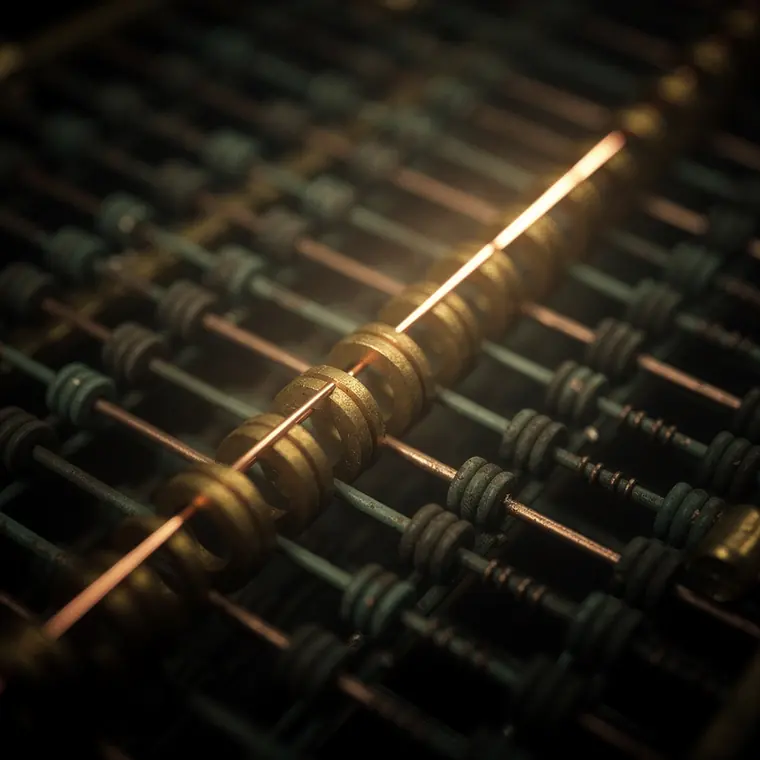
A single fine copper wire running diagonally through a core plane, followed close along its run, passing through ferrite ring after ferrite ring in a straight line, the nearest rings sharp and the rings ahead blurring out of focus in shallow depth of field, the surrounding grid of wires and rings a soft regular pattern behind, extreme close-up along the wire so its diagonal run fills the frame, soft backlight coming through the matrix and glowing along the wire's edge, deep black beyond.
- What it was used for
- The sense wire was the one wire that ran through every ring of a core plane. In the Smithsonian's Whirlwind plane it lies diagonally and threads all 1,024 cores, alongside 32 vertical and 32 horizontal address wires. Its task: when the two half-currents flip a core, the reversal betrays itself as a pulse of voltage on this wire. If no pulse comes, the core was already in that state. The answer of the whole array thus arrives over a single line, and only that makes the arithmetic work: 32 plus 32 plus one wire for 1,024 bits.
- What was new
- Reading was done by writing. The store has no tap that samples a state; it tries to flip the core and infers from the pulse on the sense wire what was there before. The price is built in: reading destroys the value. Every read must write the old state back within the same cycle, or it is gone. The three wires per core were not the final form: according to the Amsterdam computer museum, later planes came to four wires per core and stacked arrangements to as many as five.
Connections
Every connection names its kind. “Forerunner” on its own would be a claim.
- Works withThe First Core Plane1951Several wires run through every core of the array: two drive wires for row and column, each carrying half the switching current, and "another wire threaded through the core, the 'sense wire'". Only that wire makes the flipping of a core readable; the read destroys the value, which must then be written back.Source: Core memory - Computer Museum, Universiteit van Amsterdam · 1953: Whirlwind computer debuts core memory - Computer History Museum, Storage Engine