The Threading Needle
1955 · Hand Assembly · Work 623 of 1,871
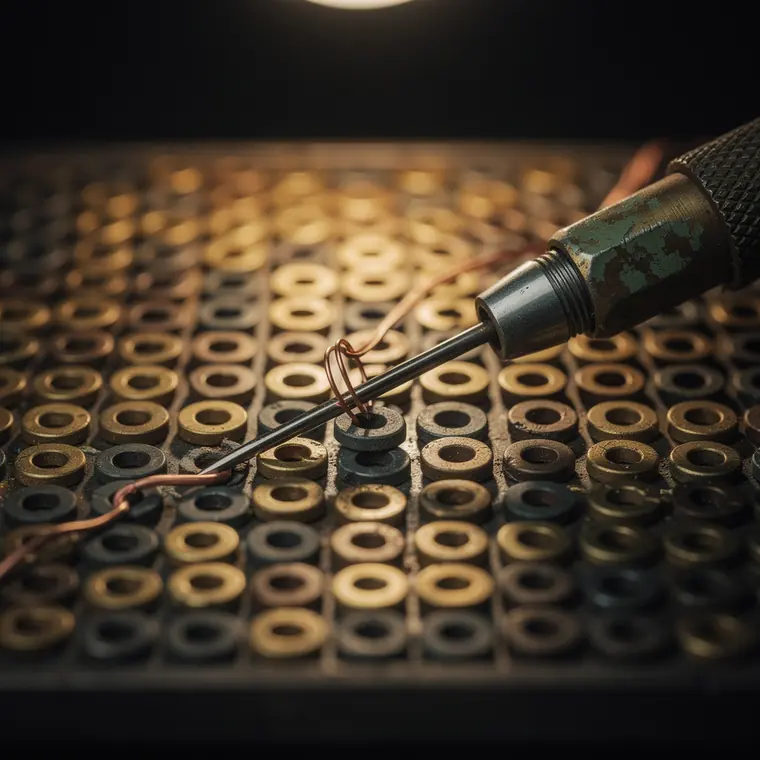
A threading needle finer than a sewing needle held in the collet of a small pin vice, a single strand of fine copper wire passing through its eye, its point poised at the hole of one tiny ferrite ring among a dense regular grid of thousands, the nearest rings sharp and the grid beyond falling into soft blur, the pin vice of plain knurled steel, extreme close-up so the needle tip and the one ring fill the frame, soft backlight coming through the matrix behind and glinting off the needle, everything else pure black.
- What it was used for
- The threading needle was the tool of core memory assembly. It carried the wire through the ferrite ring, through a hole the Computer History Museum compares to the diameter of a pencil lead. Early rings, the same source says, were one sixteenth of an inch across, about 1.6 millimetres. A plane of 64 by 64 rings required four wires through every single ring, that is more than 16,000 passes per plane. The engineer Ed Blondin of A.C. Sparkplug describes the technique in an interview reported by Rosner and others: what mattered was how you positioned the needle, the hand shook, and the women operators were good at it.
- What was new
- Nothing about the needle was new. What was new was its place: the accuracy of a digital component depended on the steadiness of a hand. The Computer History Museum calls the work delicate and says it was mostly done by women using microscopes. How that was justified is reported by an unnamed engineer in Rosner and others, recalling a factory visit around 1959: the manager noted that everyone threading the wire was a woman, because it had been found that men did not have the patience for it. The barb: the skill was praised and then abolished. Mechanised threading brought a plane from about 25 hours down to 12 minutes.
What the sources leave open: Blondin's account is paraphrased, not quoted: the interview was seen only as reported in Rosner and others 2018, and the original recording was not consulted. Blondin speaks from manufacturing for the Apollo Guidance Computer in the 1960s, not of the plane wiring of 1955.