The Core Stack
1957 · Memory Stack · Work 625 of 1,871
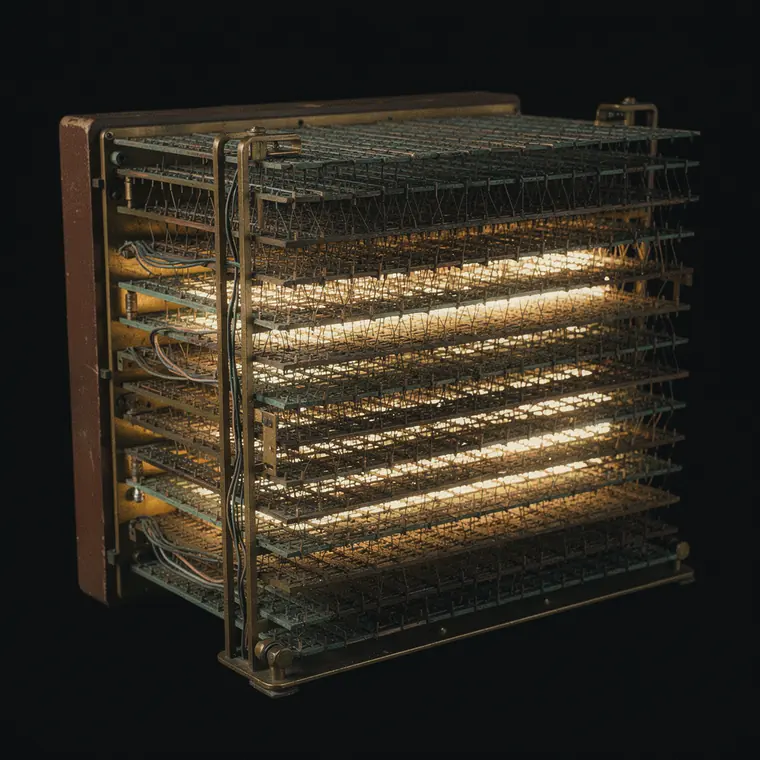
Many core planes stacked with thin spacers between them into a solid block of woven grids, seen from a corner so all the layers show at once as a stepped edge, the planes joined by fine jumper wires running down the corners, the block about the size of a book, its edges of plain bakelite and brass, the block filling the frame edge to edge, soft backlight coming through the layered matrices so each plane glows as a thin bright sheet within the dark block, the stack alone against pure black.
- What it was used for
- The core stack is the block into which the separate planes were stacked: one plane carries one bit of every word, the stack carries the whole word. The Computer History Museum describes the stack of the IBM 7302 Core Storage, designed 1957 to 1958 for the IBM 7030, called Stretch: 72 planes, each an array of 128 by 128 rings, that is 16,384 rings per plane and just under 1.2 million rings in the stack. Every word in the stack is 72 bits wide, there are 16,384 words, and access time is 2.18 microseconds. In the IBM 7090 and 7094 the same stack was used as 32,768 words of 36 bits.
- What was new
- What was new about the stack was not the principle, since the Massachusetts Institute of Technology had demonstrated arrays of 32 by 32 rings stacked sixteen high by May 1953, but how far the form could be pushed: capacity grew by stacking more and bigger planes: 16 planes of 32 by 32 rings became 72 planes of 128 by 128. The barb lies in the physics of ferrite. The rings' magnetic properties depend on temperature, so the stack had to be heated or cooled to keep its characteristics stable. According to the Computer History Museum a heated or cooled oil bath or forced air was used, and a temperature gauge sat on the front panel. A memory with an access time of 2.18 microseconds needed a thermostat.
Further reading
- IBM 7302 Core Storage Oil (IBM 7094), Katalogeintrag 102728992, Computer History Museum
- Astrahan und Jacobs, History of the Design of the SAGE Computer - the AN/FSQ-7, IBM Research Report RJ3117, 1981 (Computer History Museum, Archiv 102686388)
- Core Memory - Computermuseum, Universiteit van Amsterdam
- Memoria a nuclei magnetici - Historical Collections, Politecnico di Milano (DEIB)