Paper Tape Reader
1950 · Perforated Tape · Work 626 of 1,871
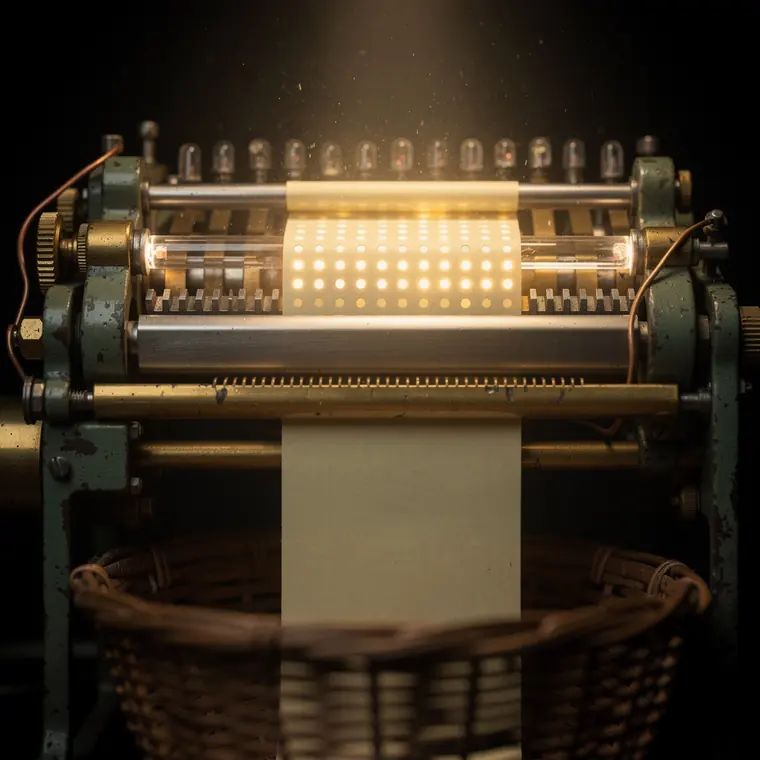
A narrow oiled paper tape running over a toothed sprocket wheel past a row of small photocells, rows of evenly spaced round holes punched across the tape, each hole throwing a small spot of light onto the far side of the reader, the tape pale and translucent with oil, a plain metal tape guide, the loose tape falling into a wicker basket below, seen close so the sprocket, the tape and the light spots fill the frame, a single soft light from behind the tape shining through the holes, the rest dissolving into pure black.
- What it was used for
- Around 1950 the paper tape reader was a common way programs and numbers got into a computer. On EDSAC at Cambridge, which ran its first program on 6 May 1949 and was in everyday service from 1951, a five-track tape reader read 50 characters per second; output went to a Creed teleprinter at six and two thirds characters per second. Tapes were blind-punched on a keyboard perforator, with no comments and no layout characters. The squares program was about one metre long. Subroutines sat as separate tapes in a cabinet, were copied mechanically onto the program tape, and afterwards went back into the cabinet.
- What was new
- The reader itself was not new: five-hole tape and the machines for it came from telegraphy. Programs on tape were not new either; the Harvard Mark I already read its instructions from paper tape. What was new with EDSAC was that the tape loaded the program into memory, from which the machine then executed it. The barb lies in the material. Tapes were punched without comments and without layout, which kept them very short; a program was therefore barely readable by anyone else, and the program library was literally a cabinet. Speeds stayed modest for a long time: mechanical readers began below ten characters per second and reached about 60 by the end of the 1950s, while Ferranti's optical readers reached about 200, according to the museum of the Information Processing Society of Japan.
What the sources leave open: The year 1950 could not be tied to a single device; the figures come from EDSAC and from documents of the EDSAC replica project. For the Ferranti Mark II High Speed Tape Reader the Smithsonian collection states 200 characters per minute, while the Japanese museum gives about 200 per second for Ferranti readers. Whether both statements refer to the same device is unclear.
Further reading
- The EDSAC Replica Project, Tutorial Guide to the EDSAC Simulator, Dezember 2021
- EDSAC - The National Museum of Computing
- Brief History of Paper Tape - Computer Museum, Information Processing Society of Japan
- Ferranti Mark II High Speed Tape Reader, National Museum of American History
- Harvard and IBM Agree to Build The Mark I - This Day in History, Computer History Museum