The Vacuum Column
1953 · Tape Buffering · Work 628 of 1,871
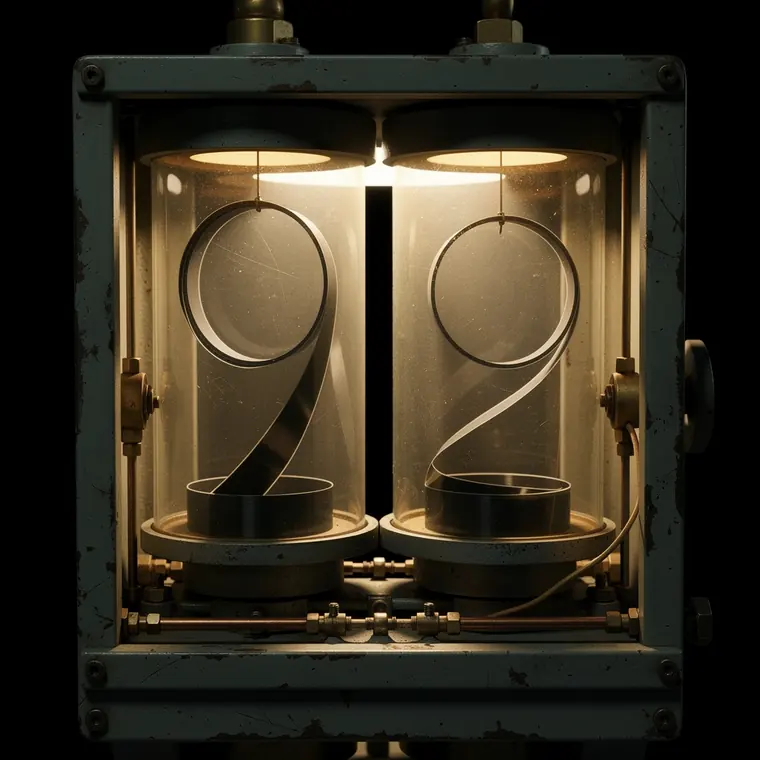
Two tall glass-fronted vacuum columns side by side in a plain steel tape drive front, loops of dark magnetic tape hanging inside each column at a different depth, one loop deep and the other shallow, the tape edges catching light as thin bright lines, the columns filling the frame edge to edge, a single soft light from behind the glass silhouetting the hanging loops, the grey steel frame around the glass, deep black beyond.
- What it was used for
- The vacuum column is the part that lets a magnetic tape drive stop and start without tearing the tape. At tape speeds of 100 to 200 inches per second the heavy reels could not be accelerated fast enough, so a loose U-shaped loop of tape hung between reel and head in a column held under suction. According to the Computer History Museum it was designed by James Weidenhammer and Walter Buslik at IBM's Poughkeepsie plant. StorageNewsletter reports that Weidenhammer first tried blowing air onto the tape, which failed, and then reversed a vacuum cleaner's hose. The vacuum switch needed a thin diaphragm: the engineer Jack Seely was sent out and came back with a pair of baby pants, which worked.
- What was new
- That loops were needed as buffers to separate the inertia of the tape from the inertia of the reel was, according to Weidenhammer, evident; what was new was holding the loop by suction in a column: the column buffers, so the reel may stay slow. The barb is the shape that followed. The columns sat below the reels, which made the drives several feet tall; the familiar image of the computer room with man-high tape cabinets is a consequence of this solution. It lasted for decades: the IBM 3480 of 1984 replaced the vacuum columns with direct reel-to-reel control.
What the sources leave open: The sources consulted give no year for the vacuum column itself; the date 1953 could not be confirmed. The Computer History Museum describes vacuum column buffers already in the IBM 726 of 1952. The vacuum cleaner and baby pants episode appears in StorageNewsletter and in the IBM Journal paper by Bradshaw and Schroeder.
Further reading
- 1951: Tape unit developed for data storage - Computer History Museum, Storage Engine
- History (1950s): Magnetic Tape Storage - StorageNewsletter
- Bradshaw und Schroeder, Fifty years of IBM innovation with information storage on magnetic tape, IBM Journal of Research and Development
- IBM 726 magnetic tape drive - CHM Revolution, Computer History Museum