The Splice
1955 · Tape Repair · Work 630 of 1,871
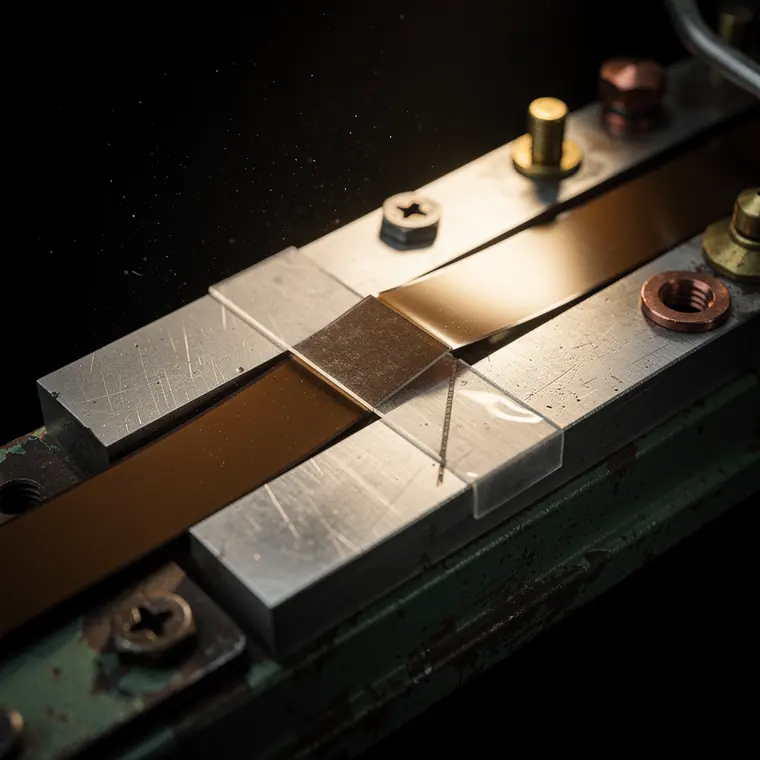
A diagonal cut joining two lengths of brown magnetic tape lying in the channel of a metal splicing block, a strip of clear adhesive splicing tape across the join trimmed flush with the edges, the join catching light slightly differently from the rest of the tape, the block of plain machined aluminium with its guide channel and cutting slot, extreme close-up so the join and the block channel fill the frame, a single soft light from behind the tape grazing the raised edge of the splice, everything else pure black.
- What it was used for
- The splice is the patched joint between two tape ends. Magnetic tape was not a flawless material. Vic Witt, an IBM Fellow until 1980, reports in the IBM Journal paper by Bradshaw and Schroeder that IBM demanded from 3M a tape which, imagined as a highway, would stretch from Poughkeepsie to Manhattan with no defect larger than a marble. Every roll was inspected one hundred per cent, by hand, with a microscope and a knife, at a test centre in Minneapolis; defects were cut out and sent back with the demand to fix that. Testing, he says, cost as much as manufacturing. The splicing block itself comes from the sound studio: a steel block with a lengthwise groove and cross grooves at 90 and 45 degrees, developed in 1952 by Joel Tall, US patent 2,599,667, in use at CBS in New York from 1952 to 1962.
- What was new
- Nothing about gluing was new; what was new was the standard a tape was held to. In the sound studio a splice counts as good if only a trained ear notices the transition - that is how the Smithsonian collection describes Joel Tall's block. For data there is no such margin, and the effort shifted accordingly: it was not the splice that improved, it was the tape that was inspected beforehand, roll by roll, with the defect cut out. The barb: the medium meant to replace the punched card was itself worked on by hand with a knife, and according to Witt the inspection cost as much as the manufacture.
What the sources leave open: No source was found for the routine splicing of data tapes in the computer room. What is documented is the cutting out of defects (Witt, as reported by Bradshaw and Schroeder) and the splicing block from sound-tape practice (Smithsonian). The year 1955 could not be confirmed.