Billing's Drum
1948 · Magnetic Drum Store · Work 632 of 1,871
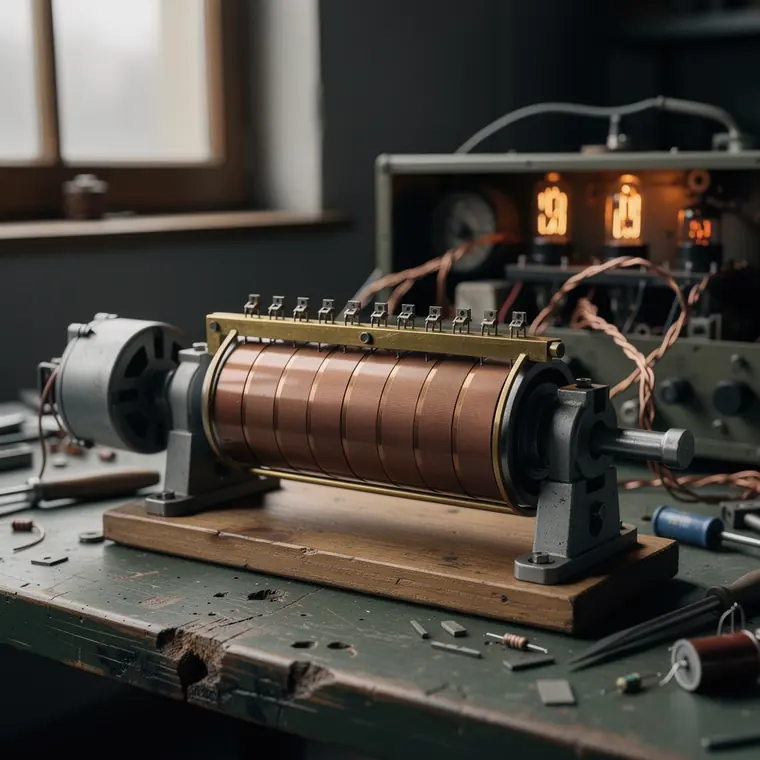
A small home-built magnetic drum on a post-war laboratory bench in 1948, a horizontal metal cylinder about seventeen centimetres long and nine centimetres across, its surface covered with strips of matt brown recording tape glued edge to edge around it, the cylinder held between two plain bearing blocks on a wooden base board, a small electric motor driving it by a short shaft, a row of tiny read and write heads on a brass bar set close along its length, thin enamelled wires leading from the heads to an open chassis of glass valves, hand tools and salvaged military radio parts on the scarred bench, grey daylight from a window with plain wooden frames.
- What it was used for
- Heinz Billing (1914-2017) was a physicist in Göttingen, where he built the first German magnetic drum store at the Institut für Instrumentenkunde. According to the Heinz Nixdorf MuseumsForum he made a rotating cylinder covered with magnetic tape in January 1948; in the summer of 1948 his first magnetic drum store ran in Göttingen and held 192 binary numbers of twenty digits. The work attracted the interest of the astrophysicist Ludwig Biermann, who needed an electronic computer. The drum became the working memory of the G1 calculating machine, which went into operation on 7 June 1952 and held 26 fixed-point numbers of 32 bits on a drum turning at 3,000 revolutions per minute. The G2 of 1954 stored 2,048 numbers and in 1956 computed the return of the asteroid Amor.
- What was new
- What was new about the drum was that a store kept its contents without power. Who had such a thing first is not clear: Andrew Booth in London and Howard Aiken at Harvard also began similar developments in 1947, and Joachim Lehmann in Dresden had the same idea a few months after Billing. The barb lies in the prehistory. According to the Heinz Nixdorf MuseumsForum, John Womersley of the National Physical Laboratory at Teddington had described a method of storing binary numbers whose technical basis - a mercury delay line - he kept secret. It was precisely those hints that led Billing to his own design. The secrecy produced a second, different method - and the store ran four years before the G1, the first machine to use it.
What the sources leave open: The dates for the beginning differ: the Heinz Nixdorf MuseumsForum gives January 1948 for the cylinder as built, the IEEE Computer Society gives late 1947 for the start of the work and July 1948 for the talk at the GAMM meeting. These are different kinds of date, not a contradiction. The IEEE Computer Society calls Billing's drum "the very first magnetic storage system for computers" but also names Booth and Aiken; the HNF only says he invented a drum store.