IBM 650 Drum
1954 · Magnetic Drum Memory · Work 633 of 1,871
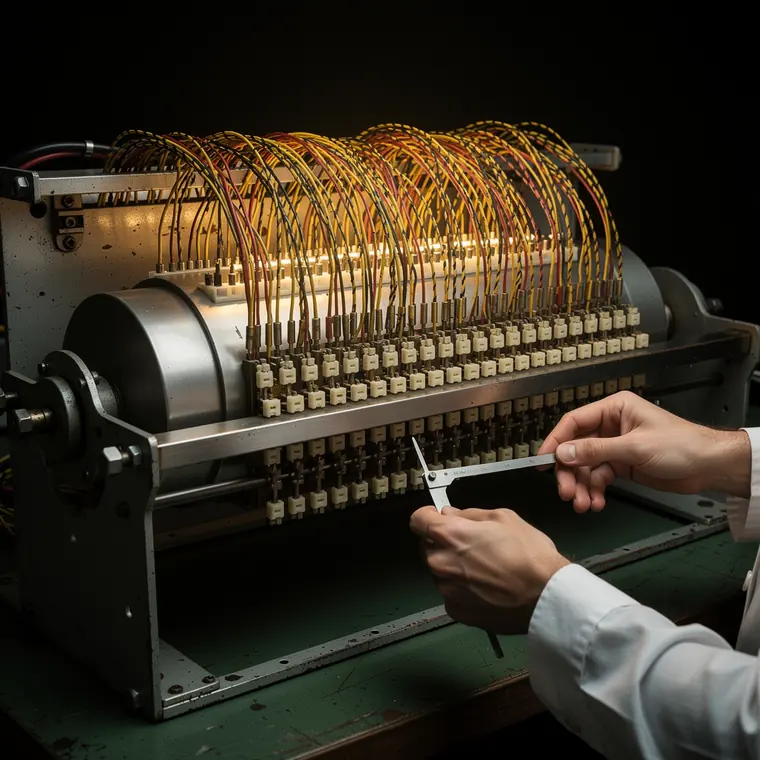
The magnetic drum of a 1954 data processing machine with its covers removed, a hollow steel cylinder about ten centimetres across and forty centimetres long, matt silver-grey, lying horizontally in a half-cylindrical cradle of bare aluminium, along the cradle dense rows of small magnetic heads in blocks set close to the drum surface, from every head a bundle of five twisted wires insulated in yellow, red and black rising in a dense upright bundle and ending in rows of cream-white connectors, grey sheet-steel cabinet frames around it, a technician's hands in white cotton sleeves holding a feeler gauge at one head, even workshop light.
- What it was used for
- The drum of the IBM 650 was not backing store but the machine's entire working memory. The 650 was announced on 2 July 1953 as the Magnetic Drum Calculator and shipped from December 1954. According to an IBM account reproduced at History of Information the drum was four inches in diameter and sixteen inches long, turned 12,500 times a minute and held 20,000 digits at 2,000 addresses. A word comprised ten decimal digits and a sign; 1,000, 2,000 or 4,000 words were available. John H. Clark gives the average access time as about 2.496 milliseconds. The calculating unit rented for 3,200 dollars a month.
- What was new
- What was new was not the drum but what it did to programming. Because everything lay on the rotating surface, placement decided waiting time: instructions were spread over the drum so that the next one was just under the head when it was needed. Computing thus acquired a geography. The barb is in the numbers built. IBM's own market forecast assumed about 50 machines; nearly 2,000 were built between 1953 and 1962. It was one of the first computers that programmers could use hands-on. And a second figure: the optional core memory of 60 words cost 1,500 dollars a month, almost half the rent of the calculating unit.