SAGE Core Array
1958 · Core Memory Unit · Work 635 of 1,871
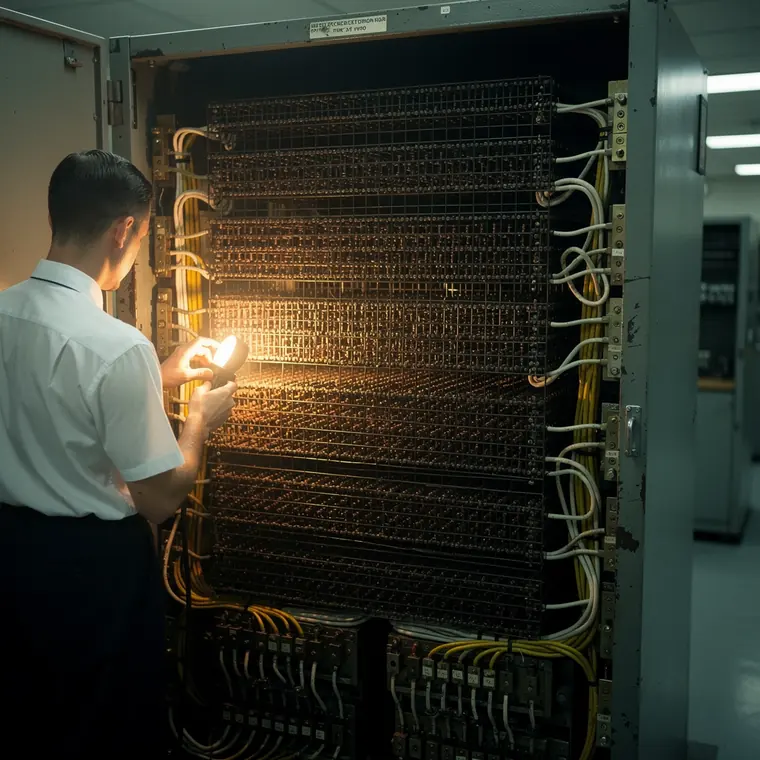
The core memory unit of a 1958 air-defence computer with its door open, a tall grey steel cabinet, inside it a stack of thirty-three square frames each about one metre on a side mounted one behind another, every frame strung with a dense dark mesh of fine wires carrying tens of thousands of tiny ferrite rings, thick looms of white and yellow wiring running down both sides of the stack to rows of connectors, a technician in a short-sleeved white shirt and narrow tie seen from behind holding an inspection lamp to the stack, rows of identical grey cabinets receding along a windowless hall under fluorescent light.
- What it was used for
- The core array of the AN/FSQ-7 was the working memory of the computer installed in the direction centres of the American SAGE air defence system. According to a Computer History Museum document the design called for 8,192 words of 33 bits, including a check bit, in two banks of 33 planes each; every plane was an array of 64 by 64 rings. That is roughly 270,000 ferrite rings per machine. The read-write cycle was to be 5.5 to 7.5 microseconds. Later a unit of 256 by 256 rings and 65,536 words was designed to replace one of the banks. One installation weighed 250 tons and needed 49,000 tubes and 3,000 kilowatts.
- What was new
- By 1958 core memory itself was no longer new: MIT had installed it in Whirlwind in August 1953. What was new was the scale and what it forced. The article at geschichte-der-informatik.de records that IBM learned mass production of memory on this contract. To that was added the duplex arrangement, decided in November 1953: two complete computers per centre, one running, one on standby. The barb is the durability. MIT's Lincoln Laboratory gives 1 July 1958 as the day the first installation at McGuire Air Force Base was declared operational; between March 1978 and February 1980, according to the Computer History Museum, both machines of an installation were out of service for maintenance on average 0.043 per cent of the time, about 3.8 hours a year.
What the sources leave open: The sources contradict each other on the day of operational readiness: Lincoln Laboratory gives 1 July 1958, while the Computer History Museum document gives 1956 for the same event and at the same time 1958 for the start of the first direction centre. That document is damaged by optical character recognition in several places.
Connections
Every connection names its kind. “Forerunner” on its own would be a claim.
- Follows fromThe First Core Plane1951SAGE's core store came out of Whirlwind. The Whirlwind II group, which from January 1953 designed the production computer with IBM, examined whether magnetic-core memories were ready as a system component and found that they were. The first bank of core storage was wired into Whirlwind on 8 August 1953. The first AN/FSQ-7 was declared operational at McGuire Air Force Base on 1 July 1958.Source: MIT Lincoln Laboratory, SAGE: Semi-Automatic Ground Environment Air Defense System