The Twistor
1957 · Twistor Memory · Work 636 of 1,871
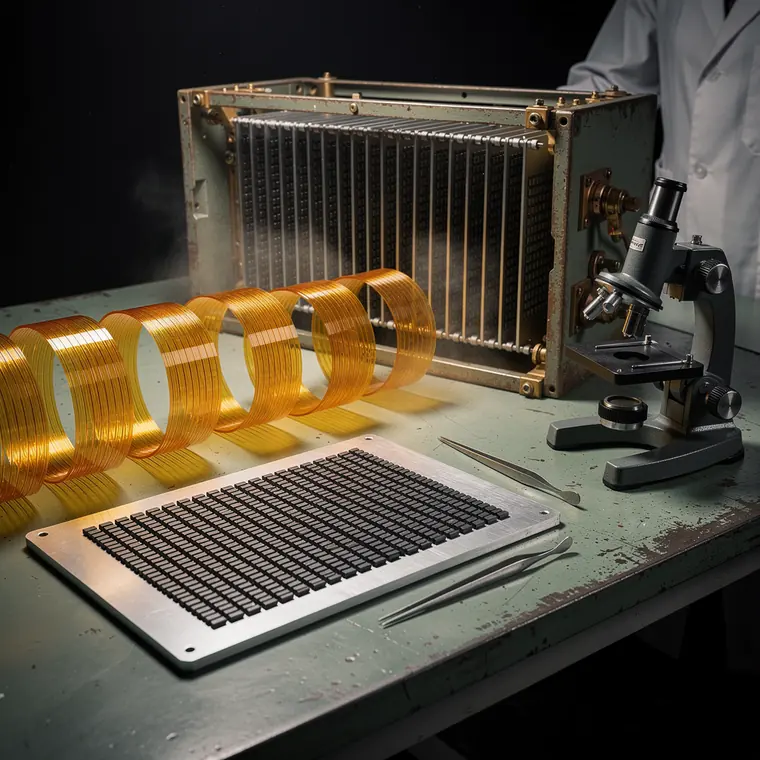
A twistor memory module on a laboratory bench in 1957, a flat card of matt silver aluminium about seventeen by thirty-two centimetres and three millimetres thick lying in the foreground, its face covered by a fine regular grid of tiny dark rectangular magnets in sixty-four columns, beside it a long flat ribbon of clear amber plastic with forty-four hair-fine parallel wires embedded along its length, folded back and forth in wide loops, behind them an open module frame holding many such cards standing upright close together, tweezers and a stereo microscope on the bench, a white laboratory coat sleeve at the edge of the frame, cool north light.
- What it was used for
- The twistor was a storage element from Bell Telephone Laboratories. In place of the ferrite ring with wires drawn through it came a twisted magnetic wire in which the magnetisation follows a helical path: the wire is store and sense line in one. Andrew H. Bobeck described it in the paper "A New Storage Element Suitable for Large-Sized Memory Arrays - The Twistor" in the Bell System Technical Journal of 1 November 1957, from page 1319. The paper starts from the Wiedemann effect, which it dates a century earlier: a magnetised rod carrying a current changes its length in a helical sense, and a rod under torsion produces a voltage between its ends when magnetised. From his own observation of a nickel wire that showed a voltage between its ends when its magnetisation changed, Bobeck concluded that the flux in the wire must follow a helical path.
- What was new
- What was new was not the physical effect - Bobeck's own opening points to Wiedemann a century earlier. What was new was the form: the paper hoped the arrays could be woven instead of threaded, and that is exactly what the title's large-sized memory arrays are about. From this line came card-changeable permanent-magnet twistors (Alexander, McAlexander, Young and Salhany, 1962). The barb: the element worked and found its place, namely in the switching equipment of the Bell System, but it did not displace core memory in computers, and semiconductor memory then overtook both. The twistor work at Bell Labs later led to magnetic bubble memory, which did not last either.
What the sources leave open: The Nokia page shows only the opening of the paper; the full text is at archive.org. The statements on where and how long the twistor was used in the Bell System come from a collector's page, not from an operator or an archive. Quantities could not be documented; for capacity the paper gives only an experimental array of 320 bits.
Further reading
- A New Storage Element Suitable for Large-Sized Memory Arrays - The Twistor, Bell System Technical Journal, 1. November 1957 (Nokia Bell Labs, Publikationen)
- Alexander, McAlexander, Young, Salhany: A Permanent Magnet Twistor Memory Element of Improved Characteristics, Proceedings of the Seventh Conference on Magnetism and Magnetic Materials, 1962
- Twistor Memory - chipsetc.com (Sammlerseite)
- Bobeck: A New Storage Element Suitable for Large-Sized Memory Arrays - The Twistor, BSTJ 36 (6), November 1957 (Volltext, archive.org)