IBM 1301 Disk Storage
1961 · Disk Storage Unit · Work 637 of 1,871
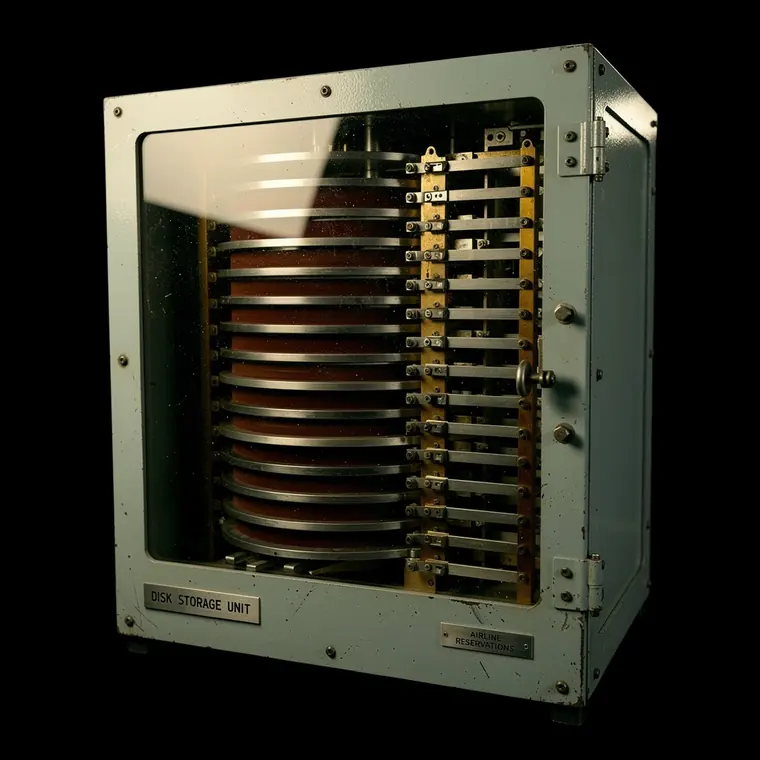
A disk storage unit of 1961 in an airline reservations computer room, a cabinet about one metre seventy-five tall in pale grey-blue sheet steel with a large glass window, behind the glass a stack of twenty-five metal disks sixty centimetres across on one vertical shaft, their surfaces dark red-brown with bright bare metal rims, about two centimetres of space between each disk and the next, at the side of the stack a vertical carrier with fifty flat aluminium arms reaching between the disks all at once, a small slider with a head at the tip of each arm, the arms caught halfway into the stack, raised white floor tiles, further pale cabinets in soft focus, even fluorescent light.
- What it was used for
- The IBM 1301 was a disk store for mainframe computers. One module held 25 disks of 24 inches diameter, turning at 1,800 revolutions per minute and storing 28 million characters in all. IBM announced it in 1961 and first shipped it to customers in 1962. It was attached to the large machines of the 7000 series and to the IBM 1410. The SABRE airline reservation system, pioneered by American Airlines and IBM in the 1960s, used sixteen 1301 units. The read-write head did not rest on the disk; it flew above each disk surface.
- What was new
- The flying head was not new. The Computer History Museum credits Jake Hagopian with conceiving it in 1954 and states that IBM's Model 353 and a Bryant unit reached the market with flying heads earlier; it was the commercial success of the 1301 that made the design standard. The difference lay in the air supply. The older RAMAC 350 forced compressed air under the head. The 1301 carried it on the air film generated by the spinning disk itself. Average head-to-surface distance fell from 800 down to 250 microinches, and areal density rose to 26,000 bits per square inch, thirteen times the RAMAC figure. The gain thus came not from adding something but from leaving a part out: the compressed-air plant.
What the sources leave open: The capacity figure depends on context: the Computer History Museum gives 28 million characters per module without reference to a computer line; the Columbia University page gives 28 million in the 7000 series context and 25 million in the IBM 1410 context. Access times and rental prices could not be substantiated.
Connections
Every connection names its kind. “Forerunner” on its own would be a claim.
- Follows fromIBM 350 Disk Stack1956The 1301 followed the RAMAC 350 disk store; its project aimed at ten times the RAMAC's capacity with about a tenth of the access time. The RAMAC's pressurized air bearing heads would have been too costly for that and could not reach the low head-to-disk spacing, so the 1301 became the first disk drive product with flying heads, one for each disk surface.Source: A. S. Hoagland, IBM 1301 (including Models 1301/1302 and 353), 1961 (1. März 2013)