UNIVAC 1107 Thin-Film Memory
1962 · Thin-Film Memory · Work 639 of 1,871
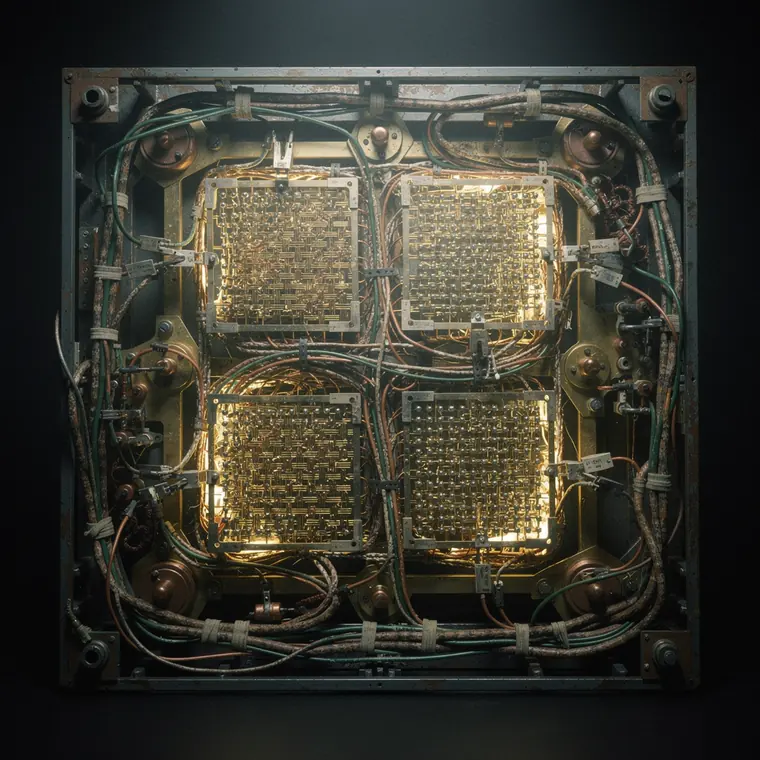
A thin-film memory assembly of 1962 on a test bench, a flat frame about sixty by seventy centimetres and thirteen centimetres deep dense with wiring in many colours, at its centre several small rectangular glass plates each carrying a regular grid of tiny mirror-bright metallic dots deposited on the glass, over the dots a fine multilayer lattice of printed copper and gold lines, each plate showing a delicate checked pattern, flat cables leading to a bench oscilloscope with a round green trace screen, an engineer's hand with a wristwatch adjusting a probe, behind the bench tall pale grey-white computer cabinets, even cool light.
- What it was used for
- The thin-film memory of the UNIVAC 1107 was not main storage but a small, very fast set of registers. According to the manufacturer's manual UT-2440 of 1961, this "control memory" consisted of 128 words of 36 bits in deposited magnetic films, with an access time of 300 nanoseconds and a cycle time of 600 nanoseconds. It held 15 index registers for address modification, 16 arithmetic registers that the programmer used as 16 accumulators, and 36 control registers for input and output, a real-time clock, repeat counters and masks. Instructions and data sat alongside in a core store of 16,384 to 65,536 words. Every UNIVAC 1107 system had the thin-film memory, whatever the size of the core store.
- What was new
- What thin-film memory could do and core could not: in the same machine it was about six times faster in access and about seven times faster in cycle than the core store, 300 nanoseconds against 1.8 microseconds and 600 nanoseconds against 4 microseconds. Instead of individually threaded ferrite rings it carried vacuum-deposited dots of ferromagnetic alloy on glass, crossed by a multi-layer wire grid serving as drive and sense lines. The barb: Sperry Rand developed the technology under contract to the National Security Agency. IBM built a thin-film memory plant at Essex Junction, Vermont; when semiconductor technology surpassed the performance and cost of thin-film, the plant was converted to volume production of integrated circuits.
What the sources leave open: The figures come from the manufacturer's manual UT-2440 of 1961; the Computer History Museum gives 1962 as the year of commercial availability but itself points to a 1960 document suggesting an earlier date. Sales figures and the cost of the memory were not found.