Temperate House Kew
1863 · Iron and Glass Hall · Work 64 of 1,871
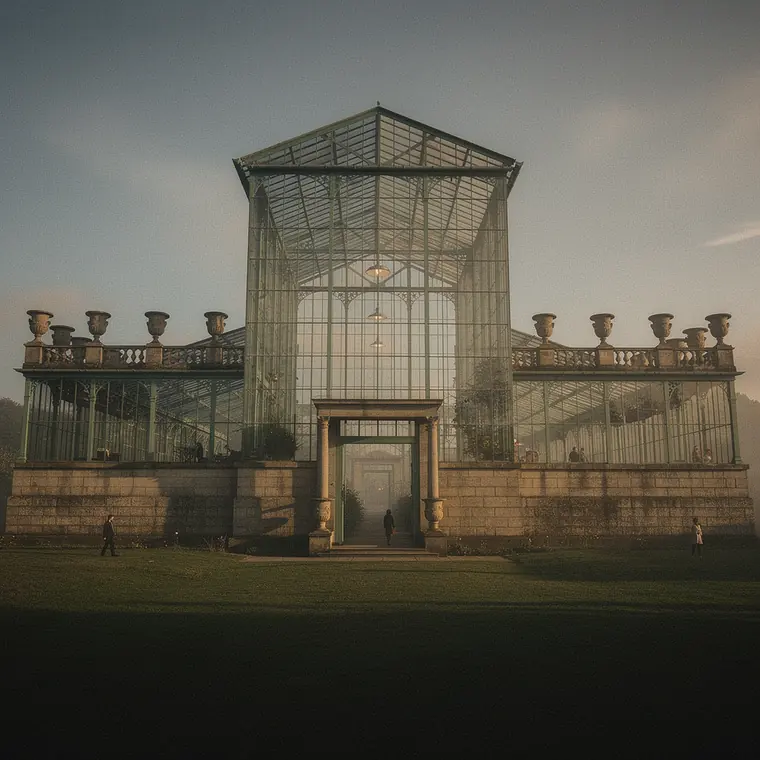
The Temperate House at Kew, straight-sided glazing above a stone plinth, stone urns standing along the parapet, linked side blocks stretching from the tall central pavilion.
- What it was used for
- House for plants of the temperate zones. Conifers and plants from Australia and New Zealand were dying at Kew in winter, and the Palm House was too warm for them. Parliament granted 10,000 pounds in 1859 instead of the 25,000 requested; Decimus Burton drew it, Cubitt & Co. built it, and the central block with its two octagons opened in May 1863. The house covers 4,880 square metres, carries 15,000 panes and is 19 metres high at its tallest point; a minimum temperature of about 10 degrees is held. After the 2018 reopening 10,000 plants of 1,500 species were put in, among them species now down to single specimens in the wild.
- What was new
- It kept twice the volume of the Palm House free of frost - more space, but a structural step backwards: to save money the building was made more rectangular than Turner's curved roof, with iron columns inside the space that the Palm House had deliberately avoided. The saving did not happen. The central block and octagons cost three times the 10,000-pound estimate, no work at all was done on the wings between 1862 and 1895, and the north wing was finished only in 1899, 36 years after the opening. The 2013-2018 restoration cost 41 million pounds; about 500 plants were taken out for it, and 10,000 put back in.
Connections
Every connection names its kind. “Forerunner” on its own would be a claim.
- Follows fromPalm House Kew1848The house was built because the Palm House was too warm for conifers and plants from Australia and New Zealand; director Hooker wrote they were suffering "beyond recovery" for want of winter shelter. Decimus Burton designed both; the new one is more than twice the size of the Palm House.Source: Royal Botanic Gardens, Kew: Celebrating the Temperate House · Royal Botanic Gardens, Kew: Secrets of the Temperate House
Further reading
- Kew: Celebrating the Temperate House (10.000 statt 25.000 Pfund, Cubitt)
- UNESCO Nomination File 1084 (rechteckige Form aus Kostengründen, Bauphasen)
- Kew: Secrets of the Temperate House (4.880 qm, 15.000 Scheiben)
- Kew Presse: Temperate House to re-open in May (41 Mio. Pfund, 500/10.000)
- Historic England, Listeneintrag 1262590: Temperate House