Der Tausend-Centner-Hammer
1877 · The Revolutionaries · Work 640 of 1,871
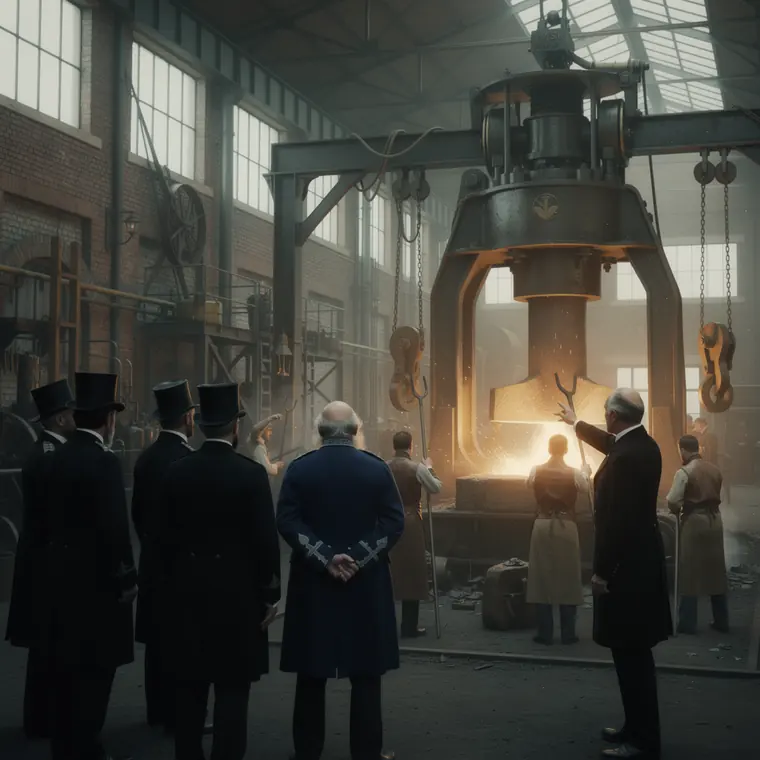
The forge hall of a great steelworks, morning of 2 September 1877, a tall brick hall under iron roof trusses, grey daylight from high windows and a skylight, an iron-plated earth floor, filling the right half of the frame a giant steam hammer, two massive cast-iron standards studded with rows of bolts, the steam cylinder above, the hammer head raised, beneath it on the anvil a white-glowing steel block held by chain hoists, four smiths in leather aprons at long iron tongs, from behind, beyond the block in the left half of the frame eight gentlemen in black frock coats, top hats and dark blue uniform tunics, in profile or from behind, faces in shadow, at the centre of this group, lit by the glow of the block, the man, a living figure in the scene and the only person whose face is sharp, a slightly stooped man of eighty with white side-whiskers and a bald crown, bare-headed, in a plain dark blue military tunic, his face turned toward the camera, the same distance from the camera as the men around him, at his right a taller gaunt man in a black frock coat, in profile, face in shadow, one hand raised toward the hammer.
- Who
- Wilhelm I (1797–1888) was King of Prussia and, from 1871, the first German Emperor. The son of Friedrich Wilhelm III and Queen Luise, he was trained as an officer and for a long time saw himself above all as a soldier. In 1848 and 1849 he argued for harsh measures against the revolution and put down the uprising in Baden and the Palatinate by force, which earned him the nickname "Grapeshot Prince". Regent from 1858 and King from 1861, he wanted to push an army reform through against parliament and in 1862 appointed Otto von Bismarck minister- president to do it. After the wars against Denmark, Austria and France he was proclaimed emperor at Versailles on 18 January 1871, a title he accepted only reluctantly. He left government largely to Bismarck, who used two attempts on the Emperor's life in 1878 to force through the Anti-Socialist Law against Social Democracy and the labour movement. Numerous monuments, most of them equestrian statues, still recall him.
- The moment
- On Sunday 2 September 1877, the anniversary of the Battle of Sedan, the eighty-year-old Emperor arrived by train early in the morning at the station of Krupp's cast-steel works in Essen. Alfred Krupp received him with twenty senior officials. After coffee and a church service the tour began at ten. The official Reichsanzeiger names the first stop: the great thousand-hundredweight steam hammer, "working a glowing steel block". The hammer was called "Fritz". Krupp had designed it himself; it had been running since 1861 and was then the largest forging hammer in the world. Its falling weight was raised from 42,500 to 50,000 kilograms, a thousand hundredweight. Then the Emperor saw the gun shop and the hall of exhibited cannon. In the afternoon 6,934 Krupp workers and some 25,000 schoolchildren lined his route. The picture shows the moment before the blow: the block glows beneath the raised hammer, and beyond it stands the Emperor with Krupp and the gentlemen.
- The other side
- The Emperor came on Sedan Day to the works whose cast steel had gone into the guns of the war of 1870–71. A year later the Reich turned on the labour movement with the Anti-Socialist Law. When in 1881 the state announced an answer to the hardships of factory work, the Imperial Message on accident, sickness and old-age insurance, the Emperor was not in the hall: Bismarck read it out because Wilhelm was "unexpectedly prevented by indisposition". The man who had stood before the hammer was absent when the state announced insurance for the workers.
What the sources leave open: What the Emperor wore and where he stood in relation to the hammer, no source read says; an ink drawing in the Krupp album shows him with Krupp at the hammer but was not examined. How the hammer looked in 1877 is known only from a view of 1911; hall and colours in the picture are a typification. The anecdote of the pocket watch on the anvil has no source. The face follows a photograph of 1884.
Further reading
- Wilhelm I. Vom preußischen König zum ersten Deutschen Kaiser (Robert-Tarek Fischer, 2020)
- Wilhelm I. 1797–1888 (Biografie) (Dorlis Blume, LeMO – Lebendiges Museum Online, Deutsches Historisches Museum, 2014)
- Die kaiserliche Botschaft Kaiser Wilhelms I. zur Sozialpolitik (17. November 1881) (German History in Documents and Images, Deutsches Historisches Institut Washington, 1881)
Sources
- Hans-Christof Kraus: Wilhelm I., in: Neue Deutsche Biographie 28 (2024), S. 137–140
- LeMO, Deutsches Historisches Museum: Wilhelm I. 1797–1888 (Kartätschenprinz, Attentate 1878, Sozialistengesetz, Sedan)
- Deutscher Reichsanzeiger Nr. 206, 3. September 1877, S. 1 (OCR, UB Mannheim)
- Allgemeine Deutsche Biographie: Krupp, Alfred (Hammer Fritz 1861, Fallgewicht, Gussstahl der Geschütze 1870/71)
- museum-digital, Sayner Hütte: Postkarte „Der Dampfhammer Fritz“ 1911 (größter Schmiedehammer der Welt, Abbruch 1911)
- Historisches Archiv Krupp, FAH 2 D 66, Nr. 82: Tuschzeichnung Kaiser Wilhelm I. und Alfred Krupp am Dampfhammer Fritz, 2.9.1877 (Findbuch, DDB)
- GHDI: Die kaiserliche Botschaft Kaiser Wilhelms I. zur Sozialpolitik (17. November 1881)