Kelvin's Tide-Predicting Machine
1876 · Harmonic Synthesis · Work 641 of 1,871
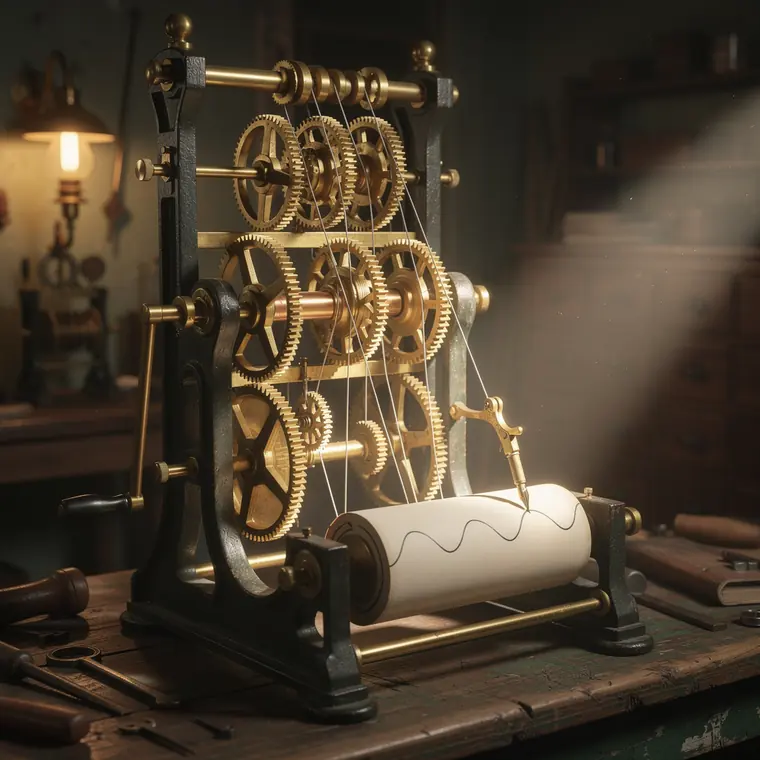
A tall brass frame on a cast iron base carrying a row of geared pulleys of different diameters, each pulley on its own crank driven from a common shaft through gear pairs of differing ratio, a single fine wire running over every pulley in a long zigzag from top to bottom, the free end of the wire carrying a pen that rests on a slowly turning paper drum, the drum wrapped in plain paper carrying a single drawn wave curve, the brass gears freshly finished and bright, the paper cream, a crank handle at the side of the frame, in a Victorian instrument workshop, the light of one gas bracket falling across the pulleys, the workshop walls receding into shadow.
- What it was used for
- The machine traces the tidal curve of a port for a whole year onto a paper strip. William Thomson, later Lord Kelvin, designed it with the help of Edward Roberts; it was built by A. Légé & Co., 20 Cross Street, Hatton Garden, London, funded by the British Association for the Advancement of Science. It sums ten astronomical tidal components mechanically: each runs on its own pulley at its own rate, one band passes over all of them, and the sum of the movements drives the pen. The Science Museum states that it traced a port's curve for a year in about four hours, and names navigators, engineers of coastal works and fishermen as people for whom knowledge of the tides is valuable.
- What was new
- What was new was not the idea of describing the tide as a sum of components; that was Thomson's own theory. What was new was that the sum no longer had to be formed by hand. The machine, however, solved only half the task: it added, it did not analyse. How large the ten components of a given port are had to be determined beforehand from tide-gauge records, and that remained hand work. Woodworth (2020) reports, for the later work at Bidston and on Doodson's own figure, about ten working days of six hours each for forty components in the harmonic analysis, while setting up the Doodson–Légé prediction machine there took about one hour. For the missing half Thomson built harmonic analysers from 1878 onward; they had no lasting importance in tidal science.
What the sources leave open: The dating is not consistent. The Science Museum dates the object to 1872 and names A. Légé & Co. as maker; Woodworth (2020) gives the construction as 1872 to 1873. The year 1876 appears at the Science Museum only in the object number 1876-1129 and in the page address, and in neither source as the year of construction.