The Harmonic Analyser
1878 · Fourier Analysis · Work 642 of 1,871
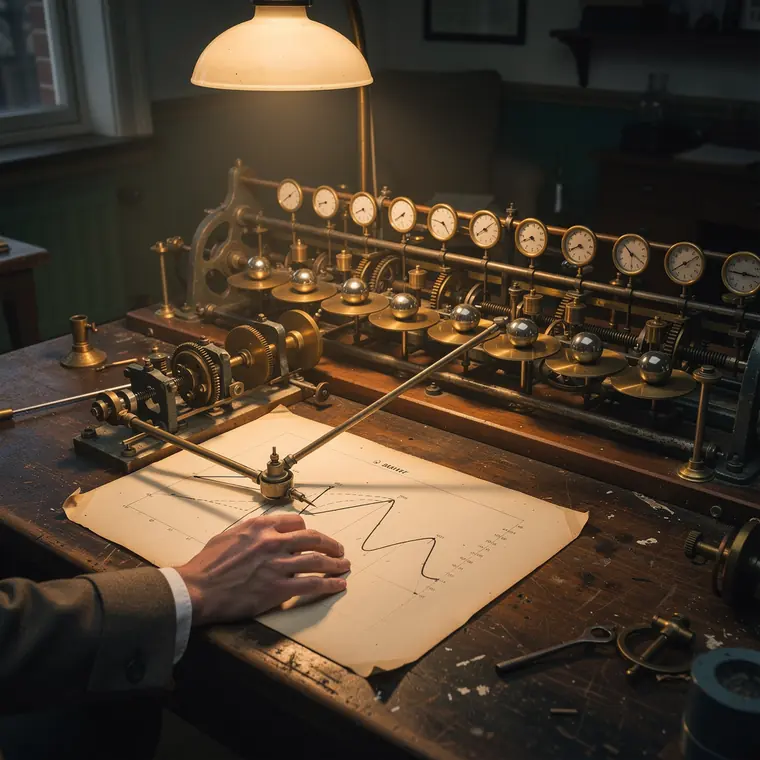
The inverse machine, a tracing stylus on a carriage guided by hand along a recorded tide curve drawn on a sheet of plain paper, the carriage driving a train of disc-globe-cylinder integrators arranged in a row, each integrator a flat brass disc with a polished steel ball resting on it and a small cylinder above taking the ball's rotation, each integrator returning one harmonic coefficient on its own small graduated dial with fine radial tick marks, the row of dials stepping away into the depth of the frame, an anonymous hand on the stylus handle, in a college laboratory of the late nineteenth century, one gas lamp above the bench, the far end of the room dark.
- What it was used for
- The harmonic analyser was meant to do the reverse of the tide-predicting machine: to extract the size of the individual tidal components from a recorded tide-gauge curve. William Thomson described it in "Harmonic Analyzer", Proceedings of the Royal Society of London, vol. 27, 1878, pp. 371–373; the paper was received on 9 May 1878. Of five integrators on the disc-globe-cylinder principle of his brother James Thomson, one forms the integral of the curve itself, the other four the integral of its product with a sine or cosine function of two periods. The machine as built thus gave the mean and two components each of two constituents; for "the two components of each of the five chief tidal constituents" Thomson planned a new machine with eleven integrators. An operator traces the curve with a pointer; the cylinders show the results.
- What was new
- What the instrument could do: it formed mechanically the integral of the product of two functions, which is precisely the operation on which harmonic analysis rests. The barb stands in the same 1878 paper: Thomson writes himself that the range of motion of the machine as built is insufficient for most tide-gauge curves. So it went not into tidal research but to the Meteorological Office; he called it "perfectly sufficient and suitable" for meteorological work. It was to be put to work there as soon as a brass cylinder matching the 24-hour length of the curves replaced the wooden model cylinder. The Royal Society archive dates the handover to May 1878; a committee of H. J. S. Smith and George Gabriel Stokes reported favourably on 5 July 1878. Robert Henry Scott and Richard H. Curtis submitted a paper on the working of the analyser at the Meteorological Office in 1886.
What the sources leave open: Thomson's 1878 paper was consulted in an online transcription, not in the printed volume. The details of the handover to the Meteorological Office come from the catalogue description of manuscript PP/8/27 in the Royal Society archive; the Scott and Curtis paper itself was not read.
Connections
Every connection names its kind. “Forerunner” on its own would be a claim.
- Follows fromThe Ball-and-Disc Integrator1876For harmonic analysis Kelvin applied the disk-globe-and-cylinder integrator developed by his brother James Thomson. The integrator evaluates the integrals from which the harmonic constants of a tidal record are found; in his 1878 communication Kelvin names five such integrators.Source: Tide prediction machines at the Liverpool Tidal Institute, History of Geo- and Space Sciences 11 (2020) · William Thomson, Harmonic Analyzer, Proceedings of the Royal Society of London 27 (1878), 371-373 (Transkription)