Doodson-Legé Machine
1949 · Tide Prediction · Work 645 of 1,871
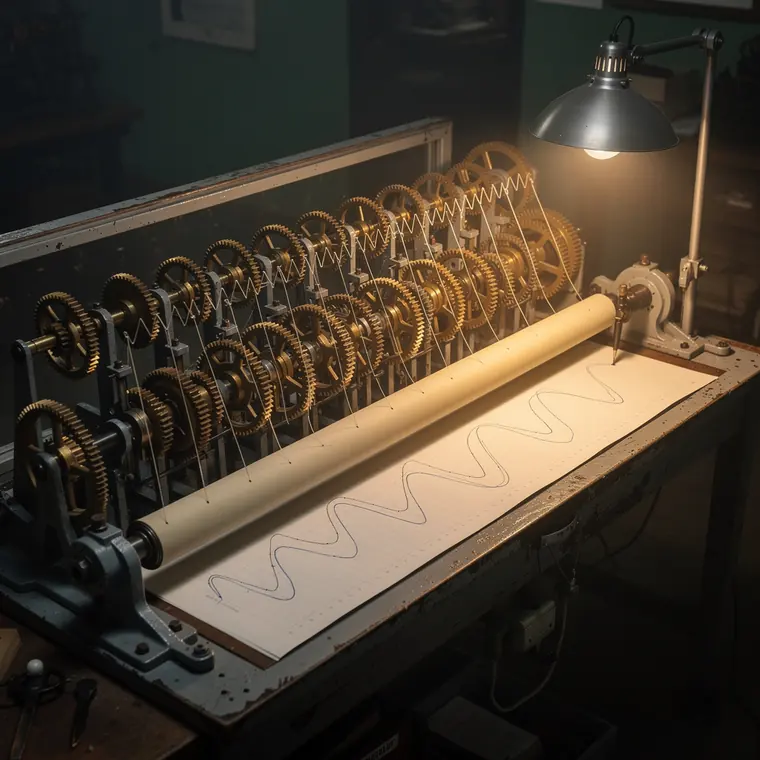
A wide tide-predicting machine in a long glazed case, forty-two gear trains standing in a row along its length, each train a stack of gears with its own pulley on a crank set to one tidal constituent, the pulleys of different diameters and the whole row of them stepping away into the depth of the case, a single wire threading over every pulley in a long zigzag, a plotting pen at the end of the machine running out a continuous curve on a roll of plain paper, the paper carrying one drawn curve, the frame grey painted steel with bright brass gearing, in a tidal institute workroom of the late 1940s, one electric pendant lamp lit over the pen end, the rest of the room dark.
- What it was used for
- The Doodson-Légé machine is a mechanical tide-predicting machine built in 1950 by Légé and Co. of London. It sums 42 tidal components and traces from them the tidal curve of a port. Arthur Thomas Doodson of the Liverpool Tidal Institute ordered it from Légé and Co. of London after asking their manager, Mr Jebson, to estimate the cost of a machine with at least 35 components. It cost 5,049 pounds and was delivered to Bidston in December 1950. There it computed the annual predictions for up to 180 ports around the world. At first it was built single-sided; in 1956 it was extended to both sides. It now stands at the National Oceanography Centre in Liverpool, having been restored between 2013 and 2015.
- What was new
- The measure is the number of tidal components: 42, against 33 on the machine designed by Edward Roberts in 1906, which Doodson bought from the Roberts family in 1929 for 753 pounds 15 shillings and later had extended to 40 by Chadburns. More components means the machine can also carry the smaller terms of a difficult port. The barb lies in the timing. The machine arrived in December 1950; in the 1960s Bidston changed over to digital computers. The National Oceanography Centre notes that digital computers use essentially the same mathematics, and that comparing the two methods shows the machine is still very accurate. It was not refuted, only overtaken; from time to time it is run to keep it in working order.
What the sources leave open: The year 1949 is not supported by the sources consulted. Woodworth (2020) and the National Oceanography Centre both give delivery in December 1950; the NOC gives 1950 as the year of construction. Neither source gives a precise end date; the NOC says the machine has been out of use since the change to digital computers in the 1960s, but Woodworth (2020) shows a running card for the machine for predictions for Hilbre Island in 1987 and 1988.