The Planimeter
1854 · Area Integration · Work 647 of 1,871
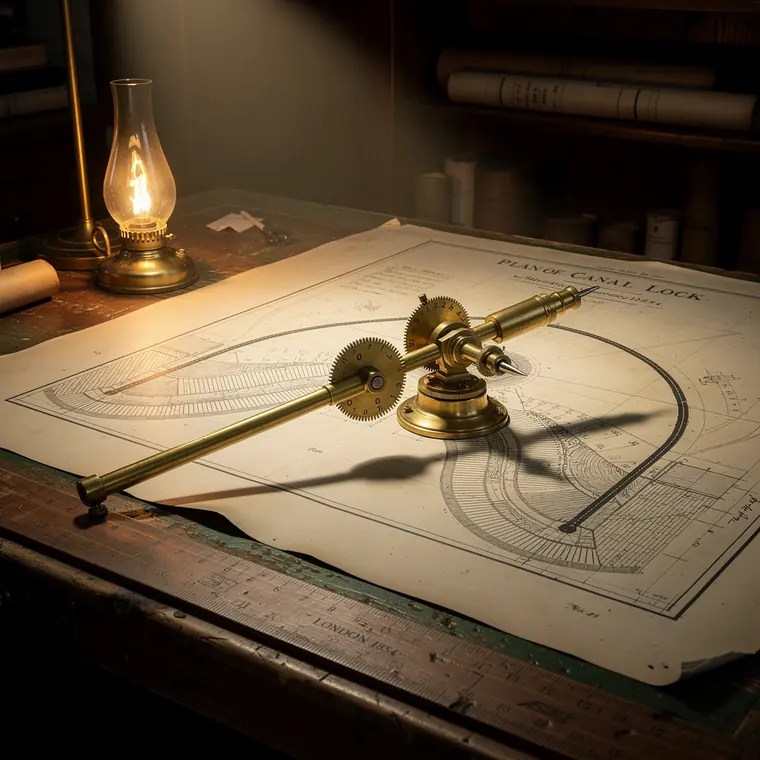
A small brass polar planimeter, two hinged arms with a weighted pole at one end and a tracing point at the other, a small graduated measuring wheel with fine tick marks and a vernier beside it near the hinge, the instrument set on an engineer's ink drawing, the tracing point resting at the start of a closed curve on the drawing, the brass warm against the pale drawing paper, a drafting board with a T-square at its edge, in a mid nineteenth century engineer's office, one oil lamp on the board throwing its light across the instrument, the office beyond it dark.
- What it was used for
- A planimeter is an instrument for measuring the area of an arbitrarily shaped figure on a sheet: you trace the outline with a pointer and read the result off a wheel. The Science Museum describes it as an instrument "for automatically measuring irregularly shaped areas on a flat surface" and names maps, drawings and photographs as the sheets in question. Jakob Amsler, a Swiss teacher and mathematician, put forward a design in 1854 that works in polar coordinates. In the nineteenth century, according to the same source, polar planimeters were used on the indicator diagrams of steam engines: the area of these pressure curves told the operator whether the engine was running dangerously or wasting fuel.
- What was new
- The difference from earlier planimeters lay in the construction. According to the Smithsonian's description, Amsler's instrument dispensed with cone and wheel-and-disc arrangements and used polar instead of Cartesian coordinates; it consists only of two arms, a fixed pole and a measuring wheel. That made it smaller and simpler. The Science Museum supplies the figure: Amsler's workshop sold about 50,000 planimeters in its first sixty years, and according to the Smithsonian it eventually made nine types of polar planimeter. The barb: the instrument was a mathematical one but was also sold by a maker of steam gauges and valves: in 1907 the Crosby Steam Gage & Valve Co. of Boston offered the Type 3 for 30 dollars.
What the sources leave open: The workshop is placed differently: the Science Museum names Zurich, the Smithsonian Schaffhausen. The figure of about 50,000 planimeters in sixty years comes from the Science Museum alone; no second confirmation was found. The Smithsonian explicitly relies on Kidwell (1998) and Mahoney (1970).