Bush Differential Analyzer
1931 · Differential Analysis · Work 650 of 1,871
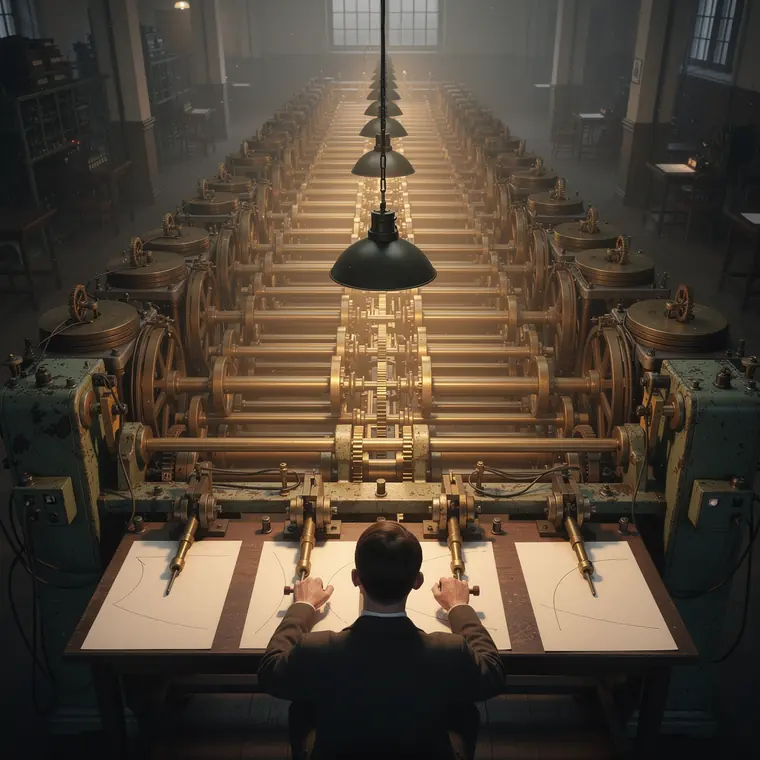
A long table of interconnected shafts running the full length of the room, a bus of parallel shafts down the centre with cross shafts and gear boxes bridging between them, integrator units mounted along both sides each a disc with its small wheel resting on it, input tables at the near end each with a plain sheet of paper and a pointer on a carriage, an anonymous operator seen from behind with both hands on the handwheels of the pointer tracing a curve, the shafts and discs staggered into depth to the far end of the table, in a university engineering hall of the early 1930s, one row of shaded electric lamps above the table with only the nearest lit, the hall beyond dark.
- What it was used for
- The differential analyser is a mechanical calculating machine for differential equations. Vannevar Bush described it in "The Differential Analyzer. A New Machine for Solving Differential Equations", Journal of the Franklin Institute, vol. 212, October 1931, pp. 447–488. At its heart are six integrators; it is, in Bush's words, "intended for the solution of ordinary differential equations of any order up to the sixth". The occasion was problems in electrical engineering with non-linear networks and in mathematical physics. For each problem the shafts are connected anew. Bush states that a problem can be set up in a few hours once the curves and the connection scheme are to hand, and that the solution then takes about ten minutes; individual units reach a precision of "one part in one thousand".
- What was new
- Bush's predecessor machine, described in 1928, had already connected integrators together, using servo-mechanisms and only for second-order equations. What was new was that the torque amplifier made the weak output of one integrator strong enough, without an oscillating drive, to drive the next. Equations up to the sixth order could now be solved. The barb lies in what the machine was really used for. In 1931 Bush names network and physical problems; according to the MIT Museum the analyser ran around the clock during the Second World War, mainly for problems of the MIT Radiation Laboratory, and was decommissioned in 1947. The machine at Aberdeen computed trajectories: according to the ENIAC account of the US Army Research Laboratory, a skilled person with a desk calculator needed about 20 hours for a trajectory of 60 seconds' flight time, the differential analyser 15 minutes, and ENIAC 30 seconds.
What the sources leave open: The details of the machine itself come from Bush's 1931 paper. The machine at Aberdeen is not Bush's own: the ENIAC account gives ten integrators for Aberdeen and installation about five years before 1939, and fourteen integrators for the Moore School. No number of trajectories per firing table and no specific backlog are named there.
Connections
Every connection names its kind. “Forerunner” on its own would be a claim.
- Works withThe Torque Amplifier1928Bush's analyzer works with wheel-and-disc integrators whose output is too weak to drive further units. The Nieman amplifier, built from contra-rotating capstans, sits behind the integrator wheel, takes off its motion and supplies the power for the next unit.Source: MIT, Vannevar Bush's Differential Analyzer (Original Nieman torque amplifier, MIT Museum) · Differential Analyzers, Engineering and Technology History Wiki (IEEE)
Further reading
- Vannevar Bush: The Differential Analyzer. A New Machine for Solving Differential Equations, Journal of the Franklin Institute 212 (Oktober 1931), 447–488
- MIT Museum, Objekt IN-2394: Integrator section from Vannevar Bush differential analyzer
- Martin H. Weik: The ENIAC Story (1961), auf den Seiten des US Army Research Laboratory